

There’s an Igbo saying – ‘Agaracha must come back,’ which translates to ‘the wanderer must come back.’ I have been on a sojourn in Europe, travelling to Germany, Amsterdam, and Paris, and I’m back to my life in Lagos. Though perhaps Agaracha does not quite apply here, as the term is often used for people running from something, sometimes, their responsibilities. I left for none of that. I left to find more.
I am thankful for these experiences. I am grateful for people – the humans I met, the lives I have touched, and the people who have inspired me. I am thankful for the food that nourished me, the places that welcomed me, the ecstasy, joys, apprehension, loves, and friendships.
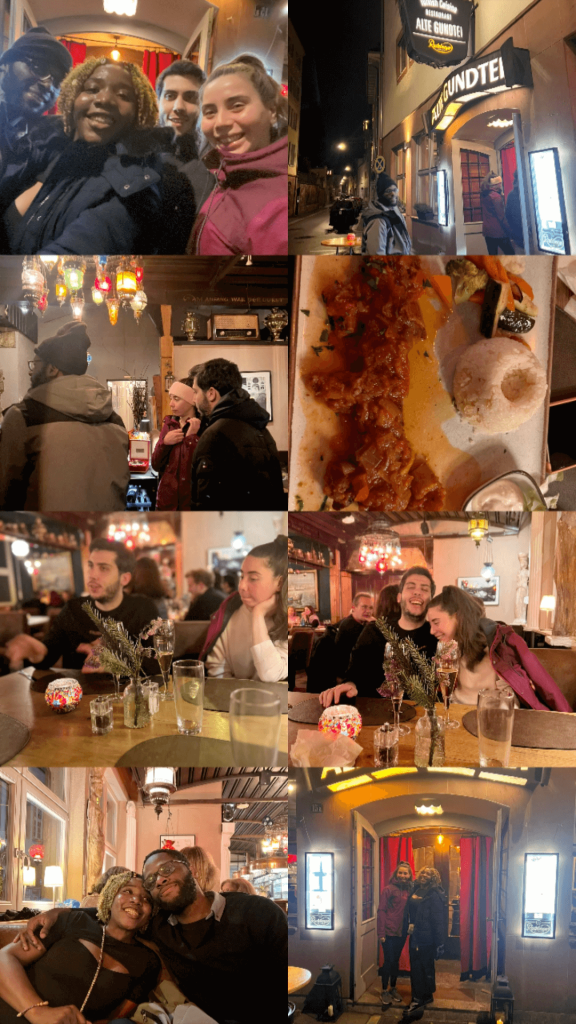
Last Wednesday, we met with some friends – Hüseyin and Tuba from Turkey. Hüseyin, who had come to Germany on a work visa two years ago, was advancing in his English. He spoke slowly, his eyes reflecting a genuine curiosity about the person he was engaging with. I appreciated this and thanked him for his thoughtful questions.
Tuba, on the other hand, felt very shy. Her cheeks turned crimson as she whispered her Turkish to Hüseyin, who then translated to us.
I thought about how similar our lives felt in that moment – Hüseyin feeling self-conscious about his command of English, and me sharing my own journey with the language; the tribes in Nigeria, the differences in the tongues we speak, even though the official language is English. I told him that even native speakers often feel challenged expressing themselves, and that he was doing well. More than well, actually. Hüseyin had something rare: a new language being learned with full attention, including its structure and logic. Most native speakers never learn it that carefully at all.
There was something else I noticed – the way Hüseyin drew his audience in, making them hang onto every word. I wondered what that would feel like for me, speaking in a language not my own, like Deutsch. How much more intentional I would have to be. How much more present.
I compared that feeling with another encounter I had the previous Saturday – a meeting I had looked forward to that did not go as I hoped. When dissimilar energies do not sync, they collide. I felt the intent behind the questions, sensed what was being studied rather than seen. For a moment, I felt less like a person and more like a curiosity on display. I sat with that feeling briefly, then let it go. But it stayed useful – a contrast that sharpened everything that came after.
Because at the table with Shalvah, Hüseyin, and Tuba, I felt something else entirely: safe.
Safe with the people around me. Safe in the conversation, because nobody was there to judge. I thought about where else I had felt that way, beyond family and close friends, and the framework of intention community came to mind.
Our lives felt so intertwined at that moment – Shalvah, Hüseyin, Tuba, and I. I reflected on how language brings people together and how it may also be what separates us.
Ludwig Wittgenstein famously wrote in his Tractatus Logico-Philosophicus: ‘The limits of my language mean the limits of my world.’ I realised that without a shared language, my world might seem small. I cannot express myself in a language only I understand, so I learn phrases like ‘guten morgen,’ which allows me to extend a warm greeting to a German, thus bridging that gap.
It can feel lacking, being unable to express yourself in one language. But I can express myself in other ways. Here we were – four individuals from diverse cultural backgrounds, each using the language of genuine intention and curiosity, finding our way to the universal language of love.
‘If I speak in the tongues of men and of angels, but have not love, I am only a resounding gong or a clanging cymbal.’
1st Corinthians 13:1
During my tour in Amsterdam, the tour guide shared something that stayed with me: ‘What creates separation is war, language, religion – because we cannot understand each other. But what brings us together is love.’
Her statement felt so fitting, as the group featured someone from the UK, another from the USA, one from Spain, and many others from across the world. Shalvah and I, Nigerians, were there from Germany, but we were gathered around one interest – to learn more about Amsterdam.
In every story of misunderstanding and war, the root is always the same: a lack of love. And when the misunderstanding ended, love was the bridge back to peace.
At the table with Shalvah, Hüseyin, and Tuba, love was the constant in our conversation. I felt so grateful and made a pact to continue to seek love in my interactions and relationships.
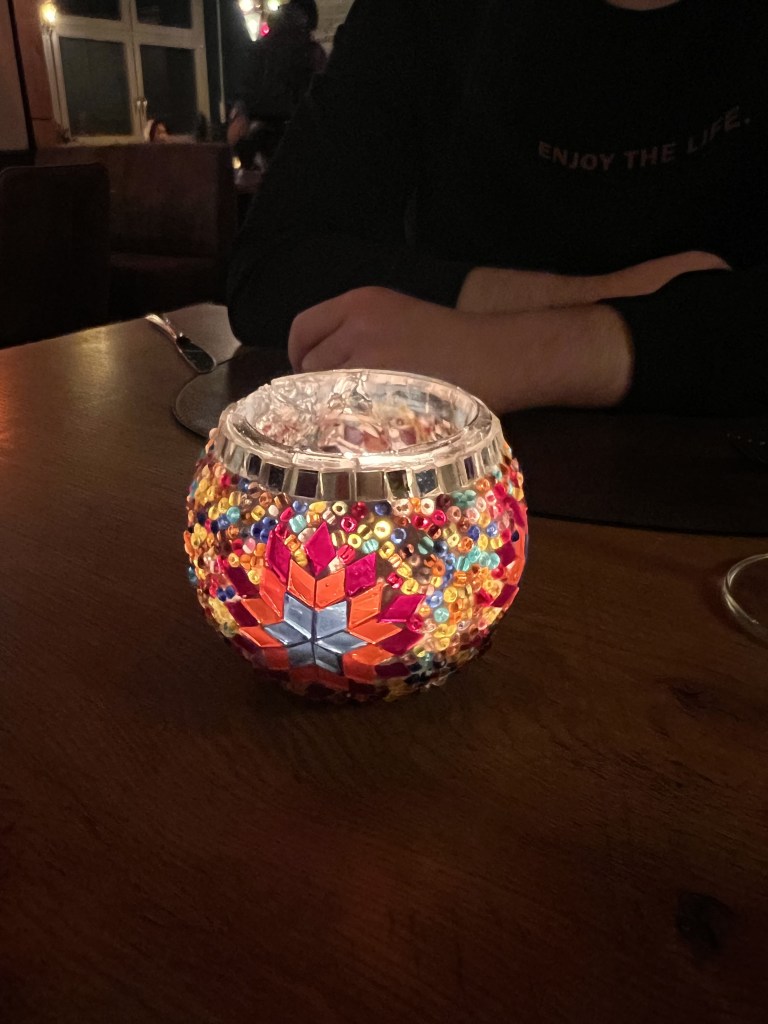
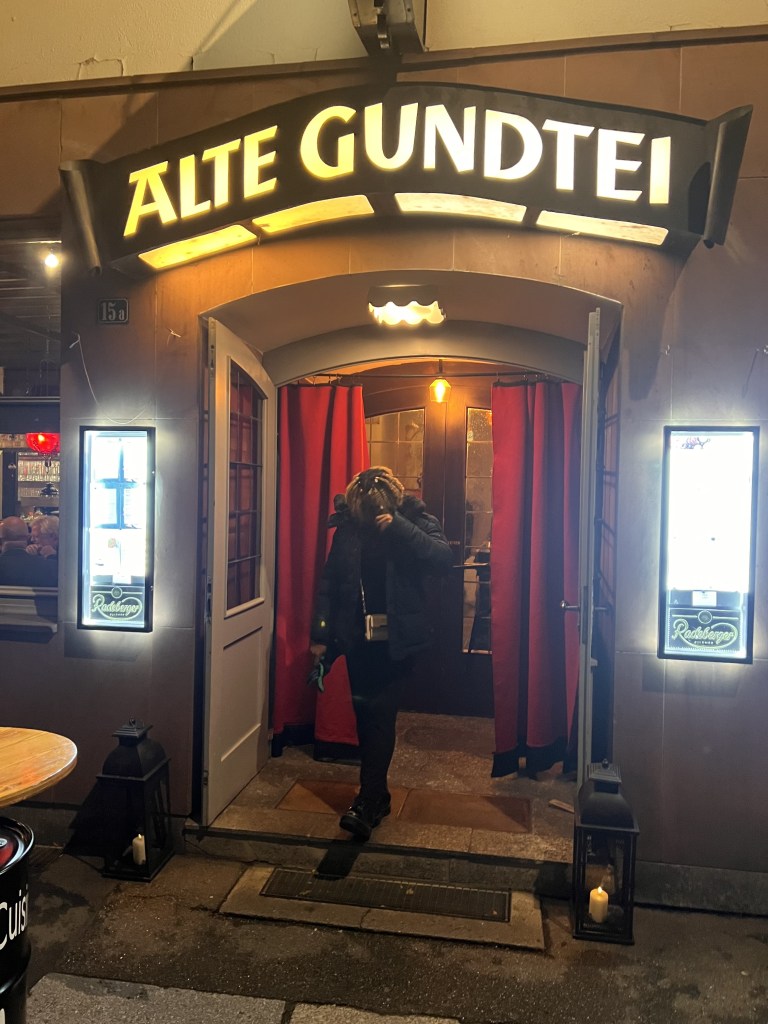
On the table that evening sat a candleholder. We were in a Turkish restaurant in the Old Town of Heidelberg, Alte Gundtei, and had just finished the best meal: Ezmeli Kebab, a Turkish dish of meat, salad, stew, and yoghurt with a side of rice. Our faces wore the expression of people who needed nothing more. At the time, nobody was speaking, as we had expressed ourselves to our heart’s content, and the silence between us felt earned – full, not empty.
The waiter had gone to get our dessert.
Then Hüseyin raised the candleholder to his eye, observing it so intimately, and commented that everything in the restaurant was Turkish, except for this one object. It was Chinese, he said.
I looked at it – a colourful mosaic of glass pieces forming a vibrant pattern, glowing warmly from within. Its light cast a soft radiance over the table, equally matching the brilliant colours from the chandeliers above, fitting the ambience as though it had always belonged there.
I thought: that candleholder is like me.
The candleholder was not from Turkey. Not from Germany. And yet, it was exactly right in that room, and it felt right in that restaurant. Not because it had been made for that space, but because of what it did there – it held light. It made the table warmer. It contributed something that the room needed without asking permission to belong.
Something that seems out of place may not really be out of place, but can fit so well with the others because of its purpose in that moment. It may simply be fulfilling a purpose that has nothing to do with origin.
One thing that connects us is our stories. Our stories are the accumulation of every experience we encounter. I was in the right place, at that table. I was whole before I came to Europe. But I became more whole because of this – this exchange of stories with them. I leave a piece of myself behind with the people and places I’ve encountered, and they have left bits of themselves with me. And that in itself is phenomenal!
 The winged time traveller