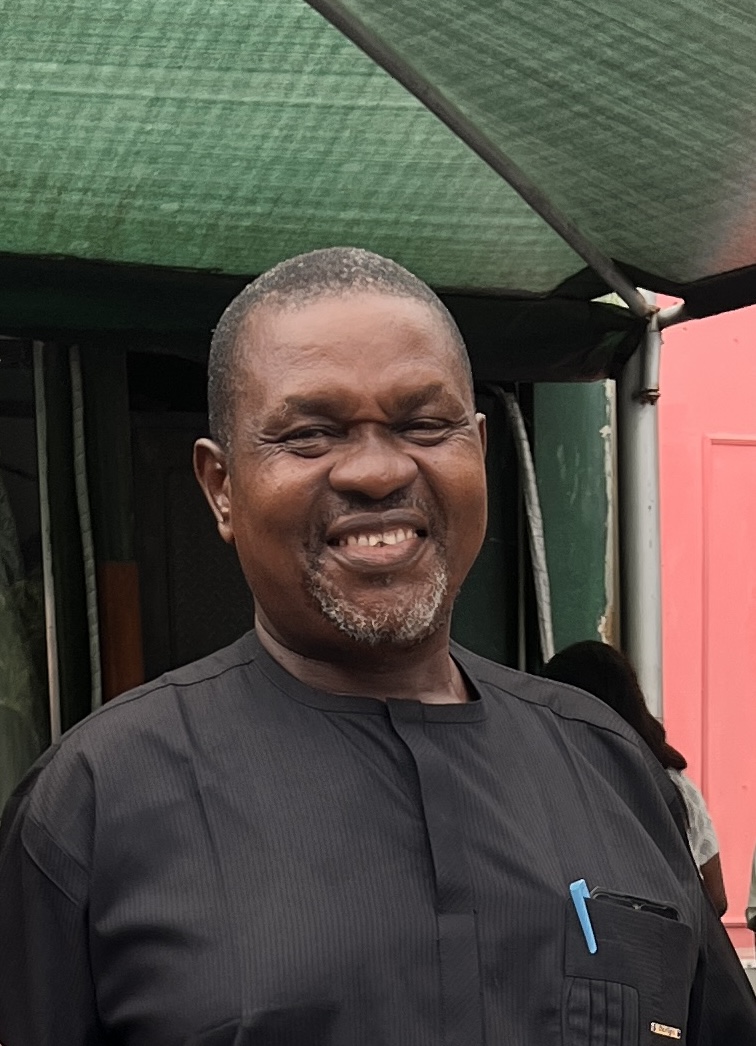
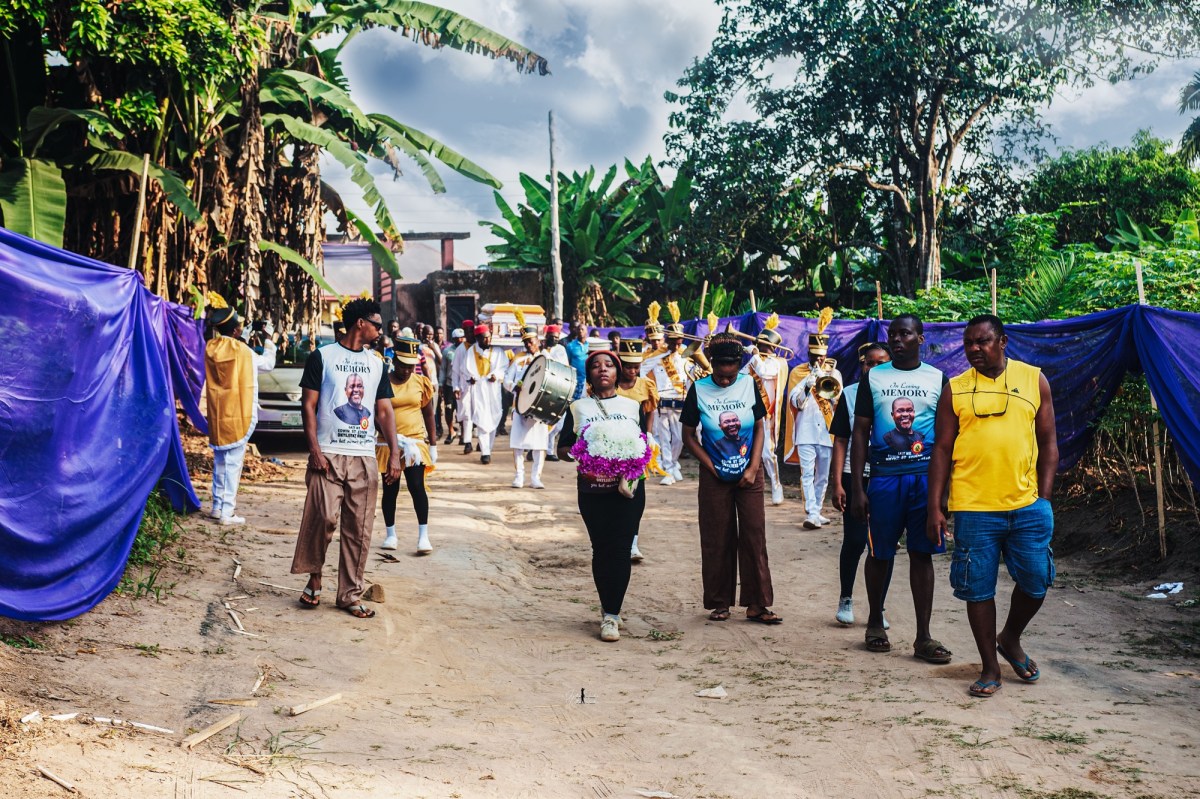
Transitioned: 20 July 2025. Burial: 3 January 2026
‘Ifunanya, daddy anwuola’ was the first announcement of your death, through Newman a memory that still sends shivers down my spine whenever I try not to think about it.
Those words, marked by shock, disbelief, trepidation, and fear, sent me into a wave of numbness I have not recovered from. My heart is pounding as I write this.
I lean into the Igbo understanding of death, searching for anything that tells me that you are still here.
Daddy, you have returned to the earth. You are in the wind, the sun, the rain splattering over my face. You are in the air I breathe, the books I read, and the dreams I accomplish.
I didn’t realise what I had been missing until you transitioned. I want to do everything ‘right’ now — but it is too late, too late to do right by you.
Chizoba said you’ve transitioned into a form we cannot explain. She told me to look at nature and draw courage from there. Autumn, fall, winter, summer are all changing seasons. Trees, pollination, insects, rivers, birds how do we account for all of these? Do I know more than my father’s chi?
My dad was only human. How did I never once imagine you could collapse? Because you were my dad. Because you were always there sturdy, steady I didn’t see you could break.
I remember the feeling I had as I stepped my feet into our compound at Ofufe after seeing you in the mortuary. Mawuu said a parent’s death yanks the ground from beneath one’s feet. You were not there to welcome us. Home no longer feels like home.
The sound I heard when I tried to move one foot in front of the other was the sound of the ground beneath me crumbling away.
How can I not feel like a stranger in my father’s house when the earth beneath me has been yanked off?
Shalvah said loss is the accompaniment of love that it is better to love and lose than to never love at all. Now I understand why people want to go first, so they never have to bear the heartache of losing the ones they love.
Wouldn’t it be easier never to have known you at all than to feel this pounding ache?
But perhaps that’s what Amakanwa meant when she said, ‘to love with our whole being, to give and receive love in all its splendour and then to mourn it when it’s taken from us seems to be part of our fate in this incarnation.’
I look for you in many things. And if I dared to imagine that I might reflect your essence, then on the days I look into the mirror and see even a glimpse of you, I realise I am my father’s daughter.
I lean into that feeling still wondering why it took me so long to recognise your face in mine.
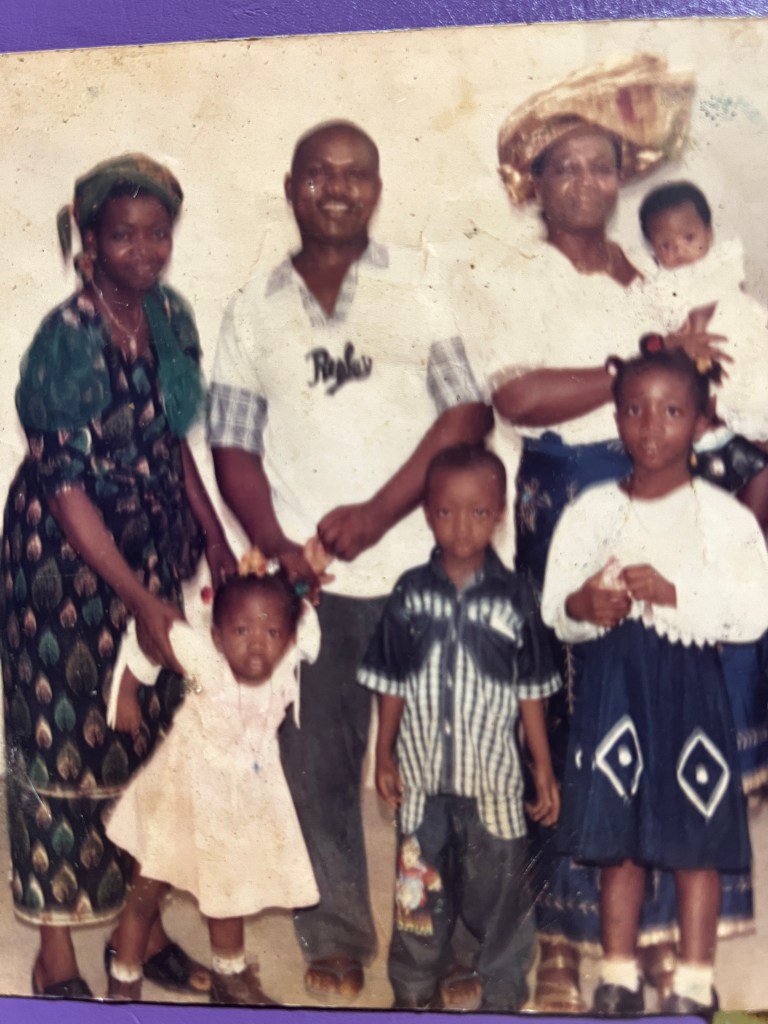
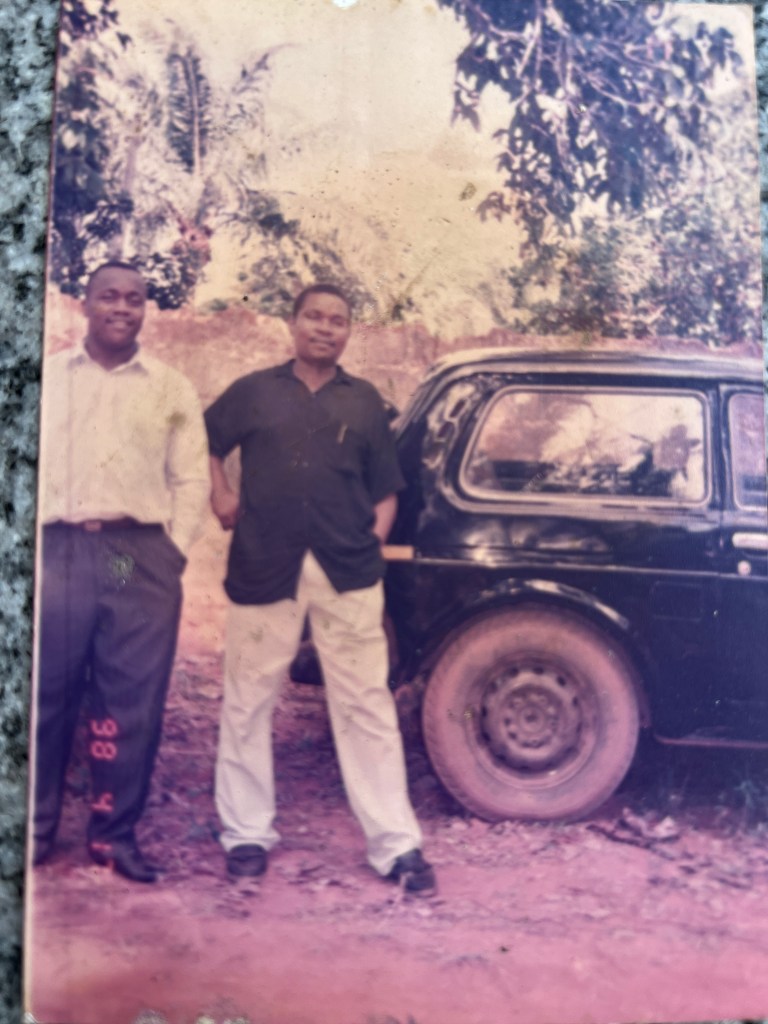
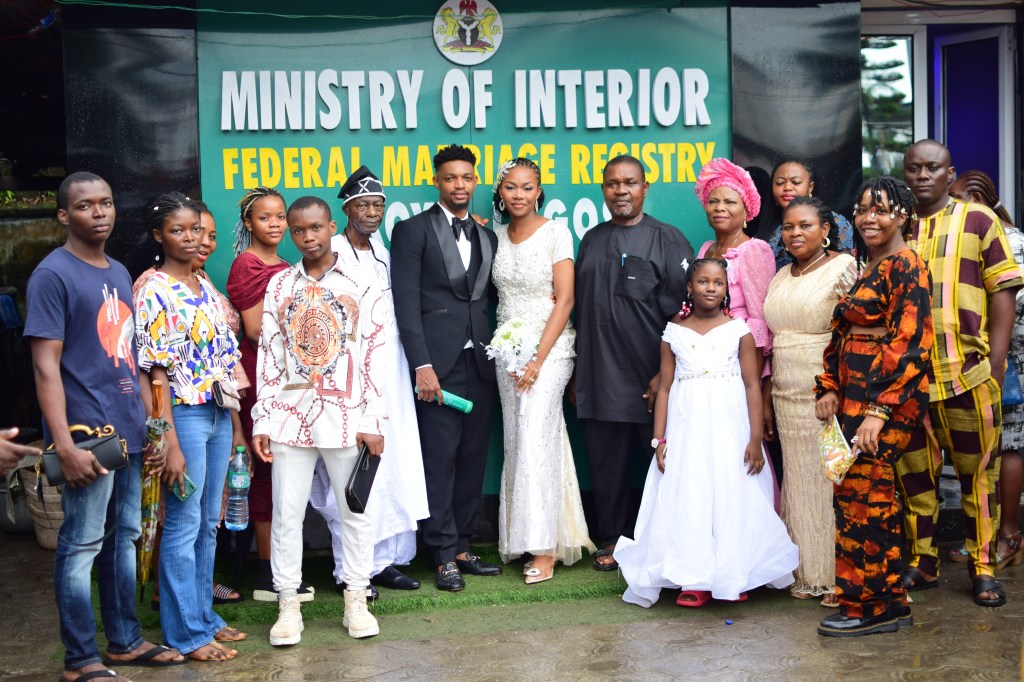
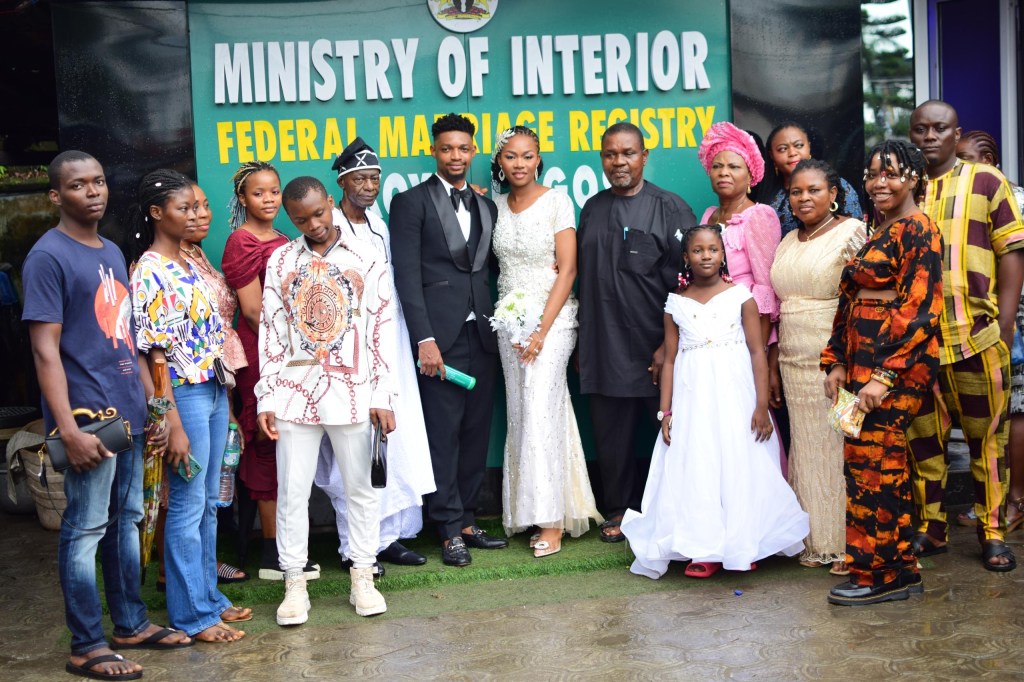
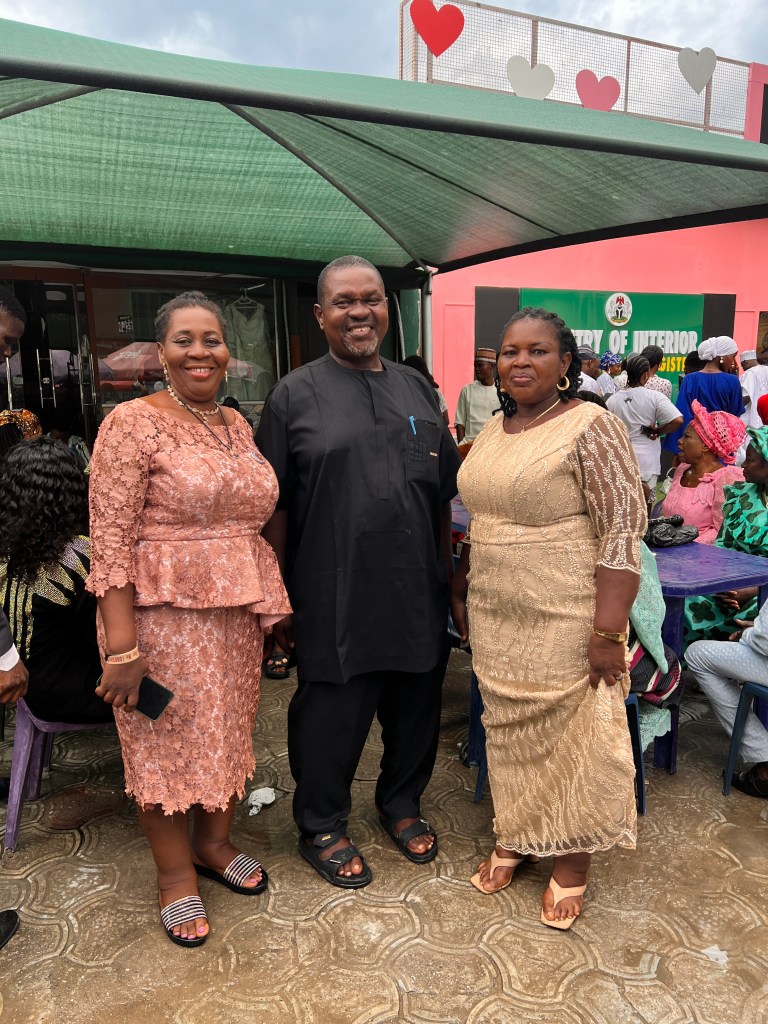
L-R: Mummy, daddy, and big aunty (my mother’s uncle’s wife), followed by my sister, Ogechi, brother, Newman, and me. L–R: Uncle Fred and Daddy.Daddy signing Oge (my sister) and Olumide’s marriage certificate at the marriage registry.Oge’s wedding – A group photo with family members. Daddy is to the left of Oge, the brideOge’s wedding – A photo with the parents of the couple. Daddy is to the left of Oge, the brideDaddy and his sisters: Aunts Eliza and Vicky
May the Almighty God receive your gentle soul, May the light of your spirit never fade. May you find rest where there is no pain, no burden, no sorrow.
And when the time comes for souls to return again, in forms we may not fully understand, may you come back renewed, whole, and surrounded by love.
May your journey beyond this world be gentle and full of light, and may your memory continue to guide us. Amen.
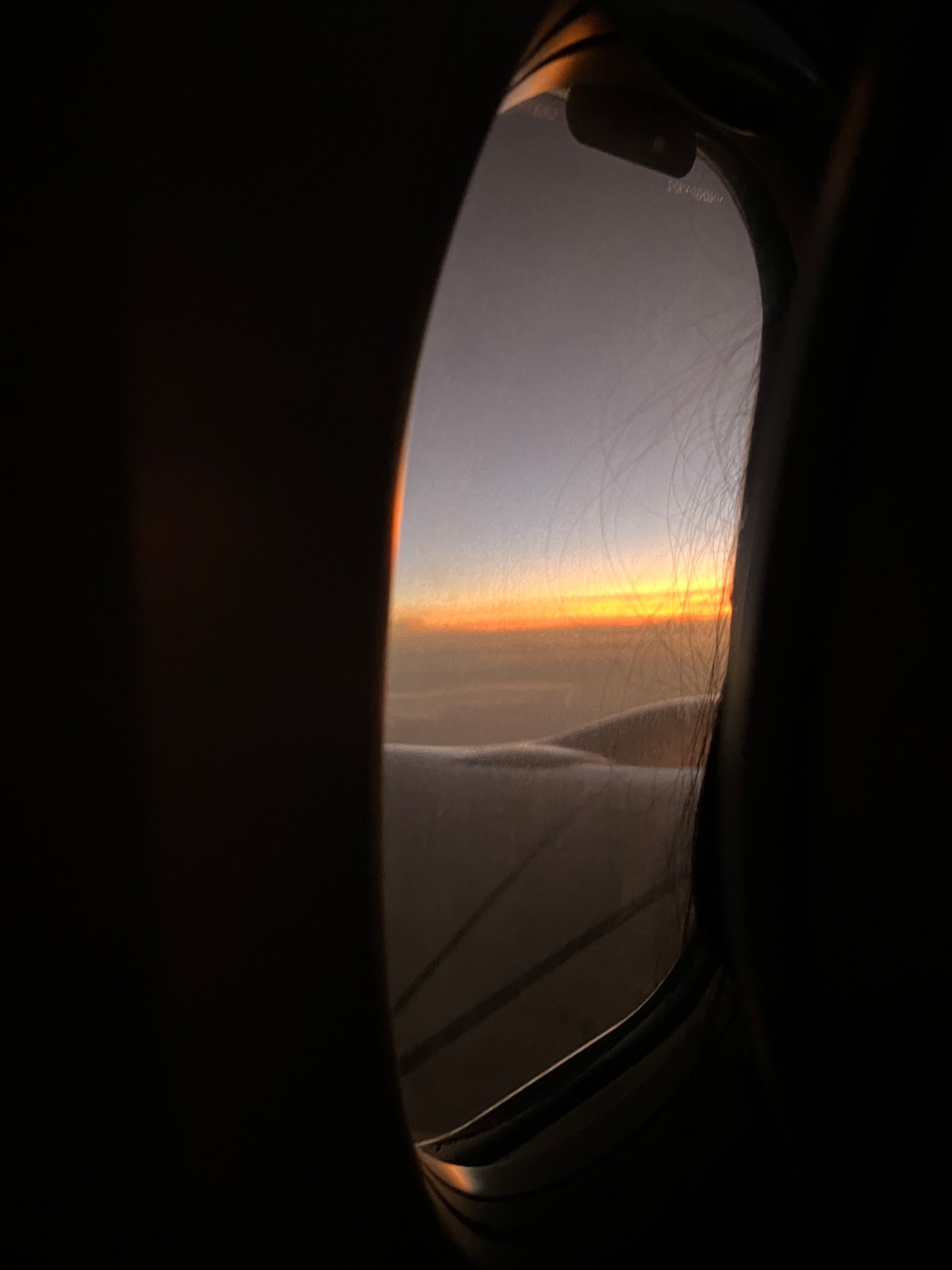
I took this photo as I came to after my experience. The serene horizon outside blends soft hues of orange, yellow, and blue at sunrise.
Today, I fainted. Or not.
I do not know what I’ve just experienced; however, it was not good. On the plane from Lagos to Nairobi, I was ready, eager, and anticipating my first visit to the Land of the Big Five, going through the series of events I had experienced with customs and the airport officials in my head.
I had journalled at the boarding gate. This trip was going to be the one that would break me out of my writing hiatus. I would journal every day. I told myself this was not going to be like my Cape Town trip where I felt overwhelmed upon my return because I had experienced a lot and didn’t know where to start.
It was going well. I had started my adventure on the plane with Young Sheldon on the little screen in front of me. I was by the window, and felt very accomplished in how I had managed the whole planning for this trip, from the e-visa to booking my flights, and even checking in online and getting a window seat without paying extra for it. I reached for the rest of my Loacker wafers, pouring the mini biscuits into my mouth with each wave of guilt. When did I start eating sweets? How do I break out of this habit?
My seat partner smiled at me sweetly as she asked where I was from.
‘Nigeria,’ I replied, my voice heavy with caution. This caution stemmed from a sense of self-preservation. At first, I wondered why she was talking to me—did she want something? Why was she being so sweet? It came from receiving countless pieces of advice from family to be wary of strangers, especially when travelling on a plane: to act cautiously with people who seem nice and not let my eyes wander away from my luggage in case they put something in my bag. It was this caution that answered first; the second voice that answered was more intentional.
‘What about you? Where are you from?’
‘Zimbabwe,’ she responded.
Then she turned to the person beside her and spoke a string of sentences in a foreign language. I suspect they came together.
There were only two episodes of YoungSheldon in the programme loaded on the TV. I watched both, then started watching Bob Hearts Abishola while side-eyeing the plane attendants pushing trays of food. I had planned to continue watching my Chinese series, but wanted to eat the food first before using the tray for my laptop. I was also starting to feel sleepy.
I caught myself falling asleep, but woke up immediately to find the food server still walking about the aisle with trays in hand. He had not served my seat yet. I didn’t want a repeat of my Cape Town experience where I fell asleep briefly on the plane from Cape Town to Johannesburg, only to find the server had skipped my seat to serve other people. My seat partner then wasn’t as nice as my seat partner on the plane from Amsterdam to Frankfurt, who shook my shoulders hard to collect my food. Anyway, I digress, but if there’s anything this proves, it’s my love for food, and perhaps maximising the value of every expense I make.
The warm towel came first. I cleaned my hands with it.
The food came next. It was white rice and beef sauce as the main dish, an almost half-serving of yellow cake for dessert, and a wrapped something that looked like bread dipped in white sesame seeds wrapped in cellophane. The smell of the sauce hit me before I saw it, and it didn’t smell like something I would like to eat. Yet, I ate it. Very carefully, I put one beef in my mouth, then another. It tasted awful.
I continued eating: beef, then rice, then sauce. The rice had some black coating on top of it that made it look like the crust of a burnt pot, though I believe, if I had investigated further, I may have found it to be black sesame seeds. I bit into the cake, but I couldn’t take a second bite. I was done with the food. At least, I ate all of the rice and beef, but not the pastries.
I found myself dozing again, then I caught a shadow of my neighbour’s hand handing my tray to a server. I don’t remember anything else until I awoke with the oddest feeling in my body.
My body felt listless and restless, caught between heaviness and a frantic urge to move. It felt as though something had changed in the air, like the air around me had thinned. It started to feel like I wasn’t getting enough air to breathe.
I suddenly became frighteningly conscious of the small space I was in, and needed to reach out for relief. But I wasn’t gasping for air, no. My stomach felt queasy, like something was caught in it and I needed to fart to release it, so I did. Panic clawed at me, insidious. Unrelenting.
I don’t remember why I was holding my stomach and tapping at the window, or why I was incredibly aware of the amount of time it would take to land. I glanced at the clock on my neighbour’s screen—it was 1:35 AM.
Time stretched, distorted.
I brought out my laptop and switched on the show I had downloaded to watch on the flight. Maybe I needed to focus on something else. The characters on the show felt small, and as I focused on their dialogues, the incredible urge to vomit and fart became overwhelming.
I shut my laptop and put it in my bag. The cord connecting my phone to the port on the TV screen was getting in my way, so I yanked it with my phone and threw both in my bag. I didn’t check if my phone’s battery was full. Everything was getting in my way, and the space was becoming incredibly smaller.
Perhaps, walking would make it better. I could get some air, or I might induce myself to vomit. I thought perhaps it was the food I ate, and maybe I was allergic to something in it, so vomiting could make everything better. It took a while for me to stand. I remember standing, then sitting, then experiencing it all again.
I looked to my right to find my seat partners sleeping. I don’t know how long it took me to bring myself to decide to go to the restroom. I tapped on my seat partner’s shoulder, and in a voice so alien from mine, whispered ‘I want to go to the restroom.’
She mumbled something back in a sleepy voice. I don’t remember her standing, but I remember standing, looking at the profiles seated on the plane.
They danced in circles. The world was spinning around me, and everything was beginning to close in on me. I thought if I could just walk to the restroom and put my finger in my mouth, then…
The next thing I remember, I looked up and saw my seat partner standing, looking quizzically at me. She said something to the other lady about already reaching out to ‘them.’ I don’t know what she was talking about. Then she said to me, ‘Maybe you’d like to sit here.’ ‘Here’ meant the other lady’s seat. I didn’t understand why she’d say that. I looked up again, and cast a lazy glance at where I was and realised I was in my seat partner’s seat. On my way to the toilet, I had slumped in her seat. I also don’t remember how I switched back to my seat.
But I remember falling in and out of sleep after this had happened and thinking, pondering over this experience that drew the life out of me. I sat still for a very long time.
When I awoke, it felt like I had been through something—like something big and unusual had hit me. Whatever it was, it was unsettling. I do not know how someone full of life could be so out of it in an instant. How had everything come undone in such a short moment? I wondered if this was what mortality felt like. An overwhelming awareness of fragility, of how life can falter in an instant. I waited for my breath, for my body to find me again.
The window was closed. I had shut it earlier in frustration. I cast a glance inwardly to gauge how I was feeling. My body was beginning to come back to me. After what felt like hours, I pulled up the window cover slowly.
The hanging clouds felt quietened. Towards the east lay a serene horizon with soft hues of orange, yellow, and blue blending at sunrise. I wondered if morning had come for me as well, as I reached for my phone in my bag to take a snapshot of this promise. Instinctively, I knew we were about to land; the aircraft felt engaged with activity. I glanced at my seat partner—she seemed to be packing up. My hand still searching in my bag, it suddenly registered in horror that my phone was missing. Panic rose as I feared I had lost it in the chaos. My seat partner smiled at me and asked what I was looking for. I said, ‘My phone.’
She offered suggestions of where it might be and asked if I had searched my bag. I stood up, now fully alert, to search the crevices of my seat, but it wasn’t there. With heightened senses, I suspiciously reached for my bag and searched through it again, and found my phone nestled in my laptop pocket.
‘Found it,’ I said tiredly, glancing in my seat partner’s direction. I owed her an explanation of what had happened with me, so I started with an apology. At the time, I didn’t realise the full extent of what had happened from my seat partner’s point of view. I had a faint memory of sitting in her seat. However, after I had offered my apology, she said they were only worried. Apparently, they thought I had just fallen asleep in her seat. When I asked how long I had been out ‘asleep‘ in her seat, she replied, ’10 minutes.’
As I opened my Notes app to journal about this experience, I thought about the fickleness of time. What is time if not a vessel for our experiences, bending and stretching to our perception, yet steadfast and unyielding as the world spins on, indifferent to our moments of stillness, angst or urgency?
This world is indeed ours; each individual experience adds up to the experience of the greater universe, and if not brought into the experience of another by a will of intention, the world spins on, unaffected, unaware of said experience. My seat partner could have become aware of the severity of the situation if the aircraft had landed and I had still not stirred.
‘Have you fastened your seatbelt?’ my seat partner’s voice snapped me back to reality from my wandering thoughts. I glanced down at my lap and noticed my seatbelt was unfastened.
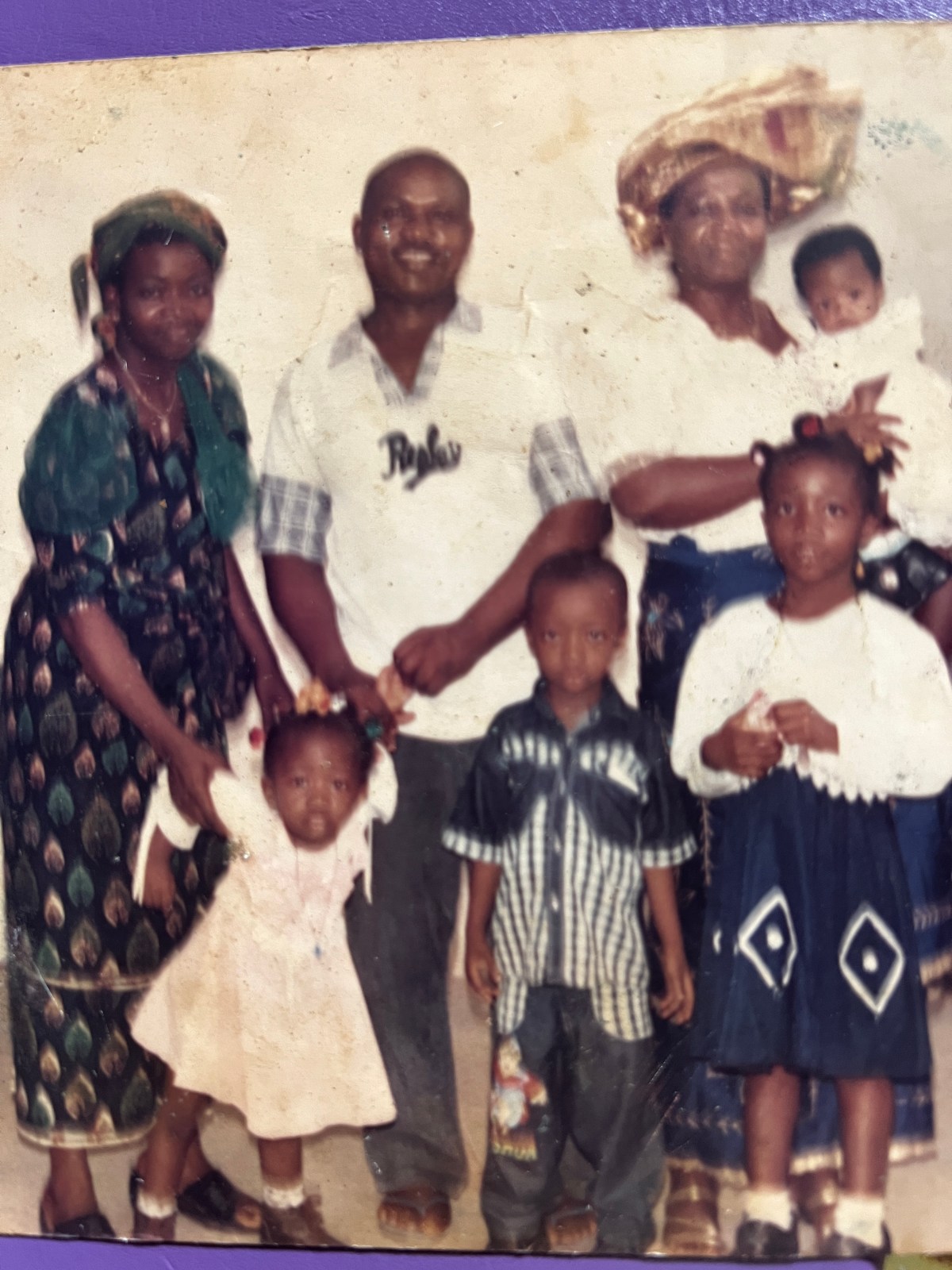
This photo was taken at St. Cyprian church, Abule Egba, after my sister's baptism. L-R: My mother, father, and big aunty (my mother's uncle's wife), followed by my sister, Ogechi, brother, Newman, and me. My mother, in the green patterned outfit on the left, is holding my sister, Ogechi, who seemed ready to fly off. My big aunty, in white blouse, is holding my baby sister, Chichi.
Years after my mother Uzoyibo died, I was never able to fully process her death. I did not realise the depth of the sorrow I carried in my heart until my visit to Death Cafe, Lagos, in 2017, eleven years after her passing. There, I wailed with so much longing for the woman I may never see again.
I learnt that it is not unusual for someone to take a long time to process the death of a loved one. Sixteen years after my mother transitioned, I still find myself in that process, not fully letting go, and not wanting to let go of her.
Why should I let go? My mother was, and still is, a big part of me. For many years, I felt guilty about her passing, wondering if I could have averted it, and haunted by the turmoil surrounding her death. My mother died in the most horrible way; she died in an accident.
It was a hit-and-run on a dark Friday, October 3rd, 2008. My mother, heavily pregnant and nearing her delivery date, had gone to buy market wares at Nkpor Main Market in Onitsha. She was a trader who sold foodstuffs in Afor Ukpor, our local market. She had also intended to pick up some baby items on her way back.
I only know the rest of the story as it was told to us. She was hit by a driver, drunk and reckless with blood on his hands, as he had taken other lives that same day with his vehicle. My mother was left lying in a pool of her own blood, unattended, as bystanders went about their activities. Nobody dared touch her for fear of being roped into the cause of her death. So, as the minutes ticked by, my mother slowly fought for her life and that of her unborn baby.
I learnt she died in NAUTH. The health professionals wouldn’t treat her without a police report. And as the hours passed, the noise in her head began to quieten, until it stilled.
My mother was the best woman. She was my world. She embodied everything good in the world, and the day she died, something inside me died as well.
My mother was Uzoyibo Clara Okolie, née Egwuchukwu, and I loved her with every fibre of my being. I remember her with every bone in my body and with every breath I take; she is in my thoughts every second of the day.
It is said that ‘grief is love with no place to go,’ and I agree.
Grief, I’ve learned, is really just love. It’s all the love you want to give, but cannot. All that unspent love gathers up in the corners of your eyes, the lump in your throat, and in that hollow part of your chest. Grief is just love with no place to go.
― Jamie Anderson
The following are some of my journal entries that capture the pain I feel for my mother. I have typed them here as I wrote them in my diary.
I grieve
I grieve. My heart is unsettled it’s filled with a deep longing. My head is a mess. My body feels empty. I can’t feel my legs, but the tightening in my chest tells me of a love that hurts so deeply. I have experienced heartbreak. No, I live with heartache. The spot meant for my heart is replaced with a deep longing for the woman I can never have again in this lifetime.
The worst pain
The worst kind of pain is not physical, like having a toothache or going through surgery. The pain from breaking bones can be cured but not the heartache that comes from remembering.
I remember the passing of a loved one Sixteen years now, and my soul still shatters at the thought that I may never see my mother again.
It’s said that time heals all scars but not mine. My scar is buried deep inside my heart, hidden behind layers of calloused skin, concealed beneath a thin casing of pain which resurfaces when I need my anchor. My mother was my anchor. With her gone, I am but a lost child.
Forgetting
I wonder why I haven’t died of heartbreak. Dying feels like the cure for this pain, but I don’t want to forget because forgetting means erasing the memories of my mother who she was when she lived. As though she were never here; as though she never happened, no, I don’t want to forget, yet I wish she were here.
Once, I asked my mother, ‘Mummy, why didn’t you get yourself some clothes too?’ She had just returned from the market with clothes she bought for us. ‘You are my priority,’ said my mother. She had only two wrappers then.
Uzoma, Ijeoma.
My mother whose priority was her children toiled and worked under the sun to make ends meet for her family. How could I forget the woman whose first words were prayers and kindness for her children? She scolded and loved in the same breath worried and toiled in the next. My mother took on many responsibilities. I have never met a person like her. She was the backbone of her family and she sacrificed a lot, oh, she did. I am grateful that I knew her, but so heart-wrenching was her death,
To the sibling whom I never met you died with mother before you could see the world you were coming into. I hope there is sunshine where you are. I hope you are both keeping each other company. Some days, I envy that you are there with her, for I don’t think I can love another as I love our mother.
I am sorry that I am only writing to you Sixteen years after your passing. There’s no excuse, but please, keep warm until my next letter. I love you.
A photograph of Hüseyin and Tuba, bathed in the cozy ambiance of Alte Gundtei restaurant, with a candleholder glowing in front of them on the dinning table
There’s an Igbo saying — ‘Agaracha must come back,’ which translates to ‘the wanderer must come back.’ I have been on a sojourn in Europe, travelling to Germany, Amsterdam, and Paris, and I’m back to my life in Lagos. Although, Agaracha may not apply in this case, as the phrase is often used for people running away from something—sometimes, their responsibilities.
I am thankful for these experiences. I am grateful for people—the humans I met—the lives I have touched, and the people who have inspired me. I am thankful for the food I ate that nourished me, the places that welcomed me, the ecstasy, joys, apprehension, loves, and friendships.
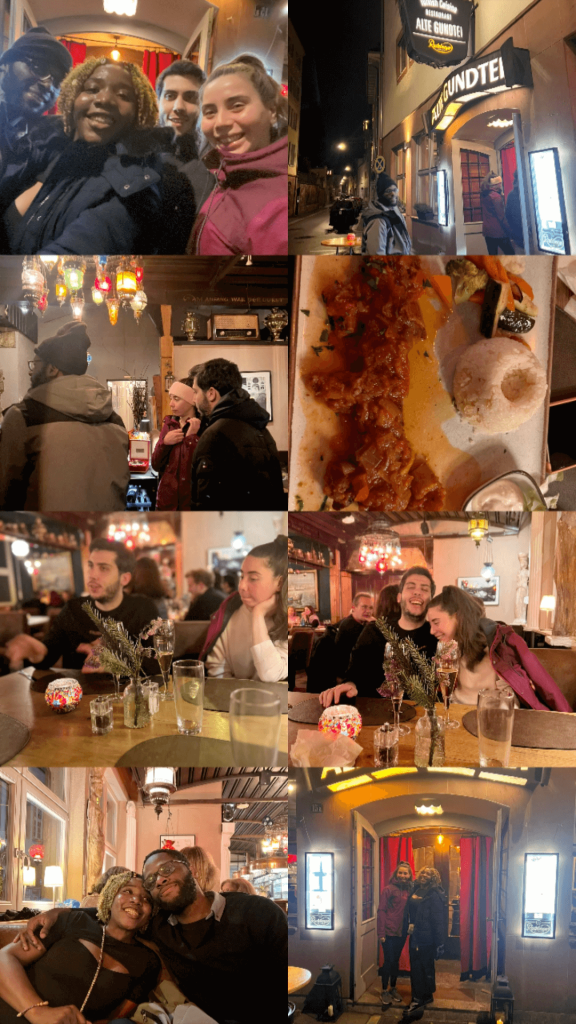
A photo collage displaying various scenes of warm moments and dining.
Last Wednesday, we met with some friends—Hüseyin and Tuba from Turkey. Hüseyin, who had come to Germany on a work visa two years ago, was advancing in his English. He spoke slowly, his eyes reflecting a genuine curiosity about the person he was engaging with. I appreciated this and thanked him for his thoughtful questions. The previous Saturday, I had a meeting that did not go as envisioned. Although I was looking forward to it, when dissimilar energies do not sync, they collide. You notice the intent in the questions asked—in the auras exhibited. I felt treated not as a person but as an object of interest. For a moment, I felt sad but grateful for that experience regardless.
However, Tuba, on the other hand, felt very shy, and her cheeks were the colour of crimson when she whispered her Turkish to Hüseyin, who then translated to us.
I thought about how our lives felt so similar in that instant – Hüseyin feeling lacking about his command of English because of his perceived shortcomings with English, and me sharing about my journey with the English language, the tribes in Nigeria and the differences in the languages we speak, even though the official language is English. I shared that even the native speakers often feel challenged expressing themselves and that Hüseyin was doing good.
He had something he could use to his advantage—a new language that he could learn very well, including its structure and grammar usage. Most native speakers don’t even know how to apply the logical structure of the language well.
I thought about how Hüseyin reeled his audience in, making them hang onto every word he spoke. How could that be for me if I expressed myself in a different language like Deutsch?
I compared my feeling at that moment with the other conversation and factored in what I felt—safe.
Safety with the people around me. Safety in the conversation because nobody was there to judge me. I thought about where I had felt this way aside from my experiences with friends and family, and the framework of intention community came to mind.
Our lives felt so intertwined at that moment—Shalvah, Hüseyin, Tuba, and I. I reflected on how language brings people together and how it may also be what separates us.
Ludwig Wittgenstein famously wrote in his Tractatus Logico-Philosophicus: ‘The limits of my language mean the limits of my world.’ I realised that without a shared language, my world might seem small. I cannot express myself in a language only I understand, so I learn phrases like ‘guten morgen,’ which allows me to extend a warm greeting to a German, thus bridging that gap.
It can feel lacking if I cannot express myself in one language, but I can express myself in other ways. Here we were, four individuals from diverse cultural backgrounds, each using the language of genuine intention and curiosity to communicate in the universal language of love.
‘If I speak in the tongues of men and of angels, but have not love, I am only a resounding gong or a clanging cymbal.’
1st Corinthians 13:1
During my tour in Amsterdam, the tour guide shared, ‘What creates separation is war, language, religion, and the like, because we cannot understand each other. But what brings us together is love.’
Her statement felt so fitting, as the group featured someone from the UK, another from the USA, another from Spain, and many others from different parts of the world. I, Nigerian, was there from Germany, but we were gathered in one interest—to learn more about Amsterdam.
In every story of misunderstanding and war, the root was always the same: a lack of love.
And when the fighting ended, love was the bridge back to peace.
At the table with Hüseyin, Tuba, and Shalvah, love was the constant in our conversation. I felt so grateful and made a pact to continue to seek love in my interactions and relationships.
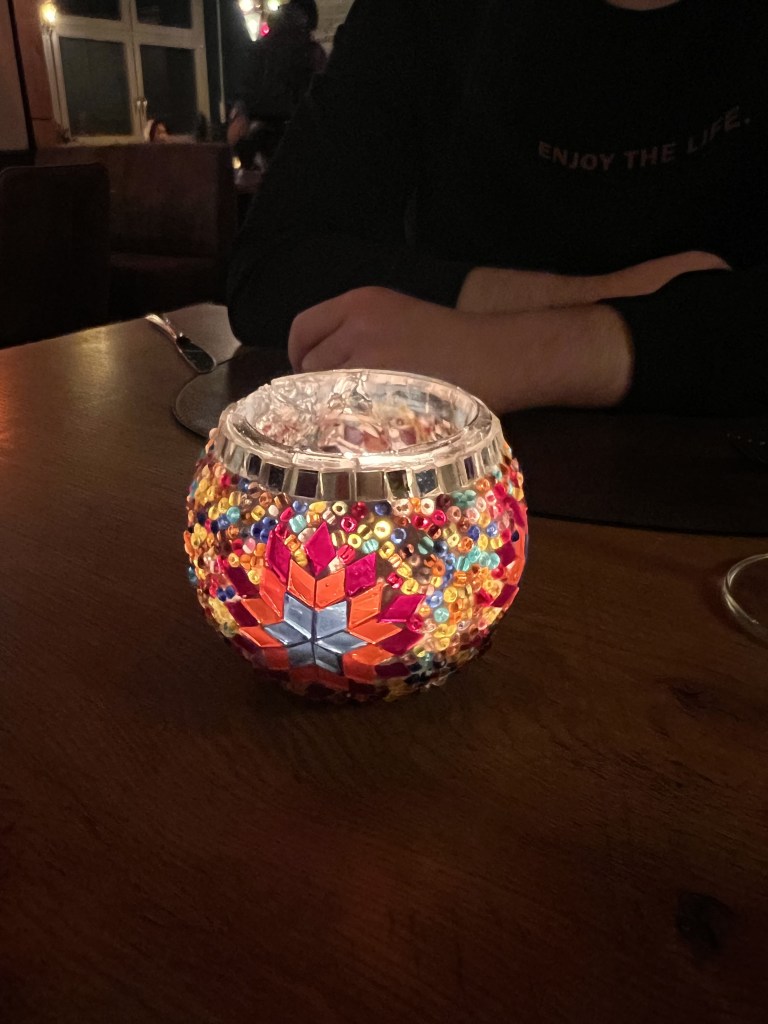
On the table was a candleholder. We were in a Turkish restaurant, and had just had the best meal—Ezmeli Kebab—a Turkish meal comprising meat, salad, stew, yoghurt, with a side of rice. Our faces wore the expression of contentment. At the time, nobody was speaking, as we had expressed to our heart content. Silence felt golden and comfortable. The waiter had gone to get our dessert. And then Hüseyin raised this candleholder to his eye, observing it so intimately, and commented on how everything in the restaurant was Turkish, but this object. It was Chinese, he said. And it felt so chilling.
I looked at the candleholder—a colourful object made of mosaic glass pieces that created a vibrant pattern, glowing warmly with the candlelight from within. Its glow cast a warm radiance over the table, its light equally matching the brilliant colours emanating from the chandeliers in the restaurant, fitting the ambience so naturally. I reflected on how that candleholder was like me, and even though it was not from Turkey or Germany, it felt right in that restaurant.
Something that seems out of place may not really be out of place but can fit so well with the others because of its purpose in that instant. One thing that connects us is our stories; our stories are a conglomeration of the experiences we’ve come in contact with.
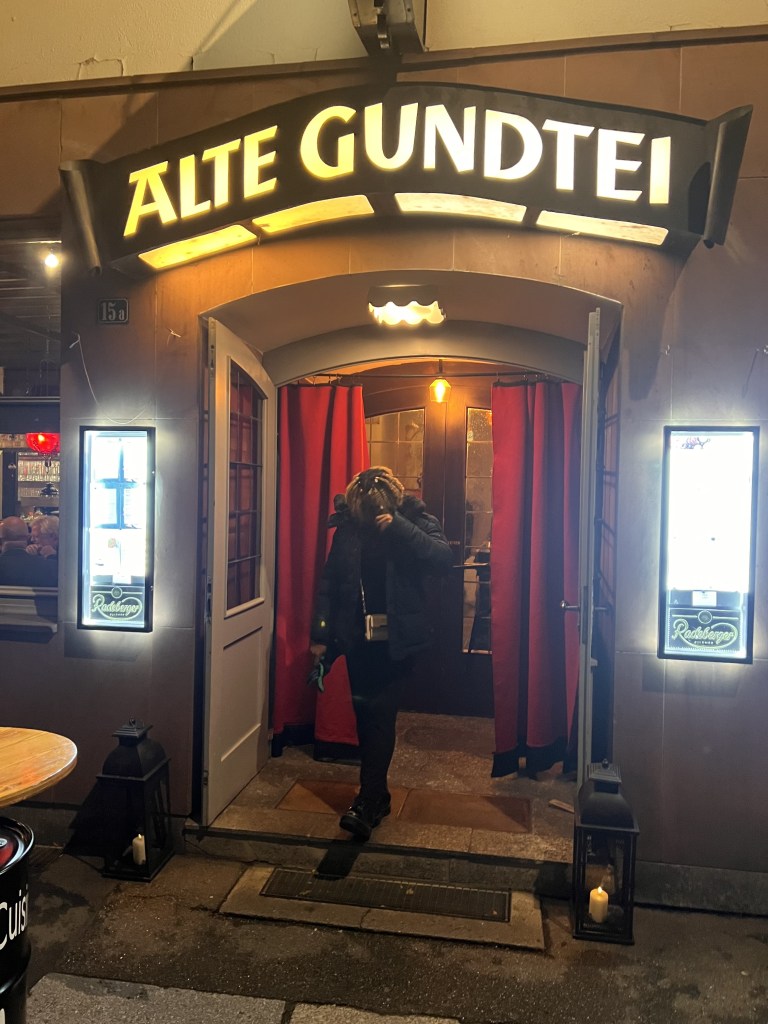
I was in the right place being with Shalvah, Hüseyin and Tuba in Alte Gundtei in the Old Town of Heidelberg, Germany. Meeting different people and learning their stories, I was whole, and my story was complete before I came to Europe, but it was also complete because of this story and experience exchange with the people I’ve met. I leave a piece of myself behind with the people and places I’ve come in contact with; they have also left bits of themselves with me. And that in itself is phenomenal!
A candleholder glowing on a wooden table capturing the warm, intimate atmosphere of the restaurant and visually representing the connection and the shared experience described in this story.A photograph of me taken at the entrance of Alte Gundtei restaurant, a charming spot tucked away in the Old Town of Heidelberg, Germany.
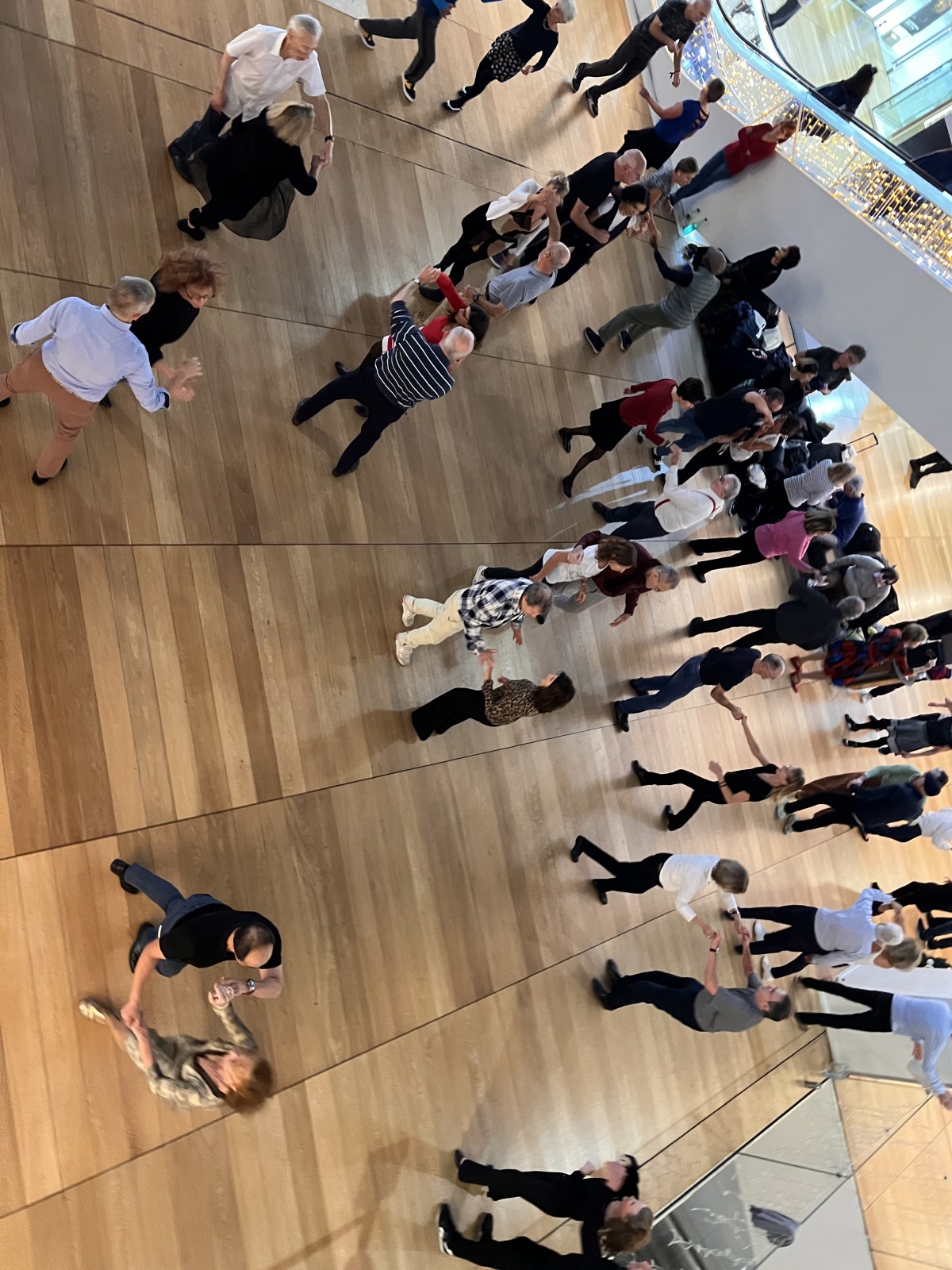
A snapshot of people dancing at Centre des Nouvelles Industries et Technologies (CNIT), a shopping mall in La Défense, Puteaux
PS: Consider these travel stories as entries from my journal.Written in haste, I hope you find enjoyment in their spontaneity and rawness.
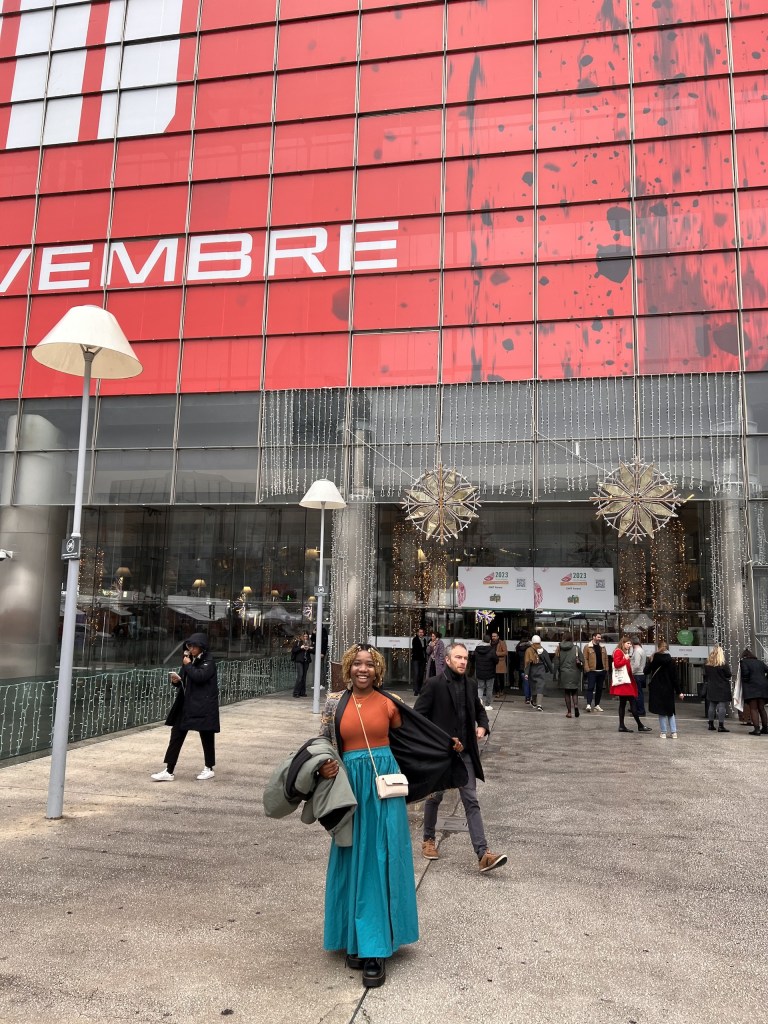
It’s Paris. We had just disembarked from the metro at Opéra and found ourselves walking into Centre des Nouvelles Industries et Technologies (CNIT), a shopping mall in La Défense, Puteaux, west of Paris, France when we followed the music to a group of people who had just turned the space into a stage. It was the most spectacular sight I had seen since entering Paris two nights ago. I was curious, so I asked a spectator also watching the dance what the group was about, and he said they were random people who started dancing when the music started playing. They were dancing to ‘Rock N Roll Is King’ by Electric Light Orchestra, a catchy, upbeat tempo and retro style music that reels people in to start moving their bodies. But we didn’t join in. We felt too restricted, not knowing the dance steps.
We were there to hang with Chisom (Som), my friend from Nigeria. I had informed her of my visit to Europe through a WhatsApp message and had arranged to meet at La Défense, but we were now at La Défense, and her phone wasn’t going through. My messages only showed a blue tick, which signalled that she hadn’t received my messages since two hours ago when I sent the first message that we were on our way.
So, we watched the dancers with glee and awe-inspired curiosity. The dancers comprised women and men in their dandy and young ages, dancing to the beat, letting go and having fun. They danced like they did not worry about the world. I wondered how a passerby could just be walking past a space and suddenly start dancing to music, or could they have been part of the different establishments in the mall, and when the song came on, they danced towards the stage? Was it a routine they’d formed?
Nevertheless, I find myself reflecting on the experience with the dancers who’ve left a lasting impression on me, and that’s what truly matters. They may not have been professional dancers, but in that moment, they embodied dance itself. Chuba and Chine, my friends from my community, often say, ‘If you claim you are something, then you are.’ Watching them dance so freely yesterday, they seemed exquisite to me. As a young lady from Nigeria who happened to be in the same space as they were, it felt as if nature had staged the most beautiful performance just for me. It made me ponder how I wish to leave my mark on this world — performing, to live and be remembered, and leave the world better.
Som was still not responding to her messages. I didn’t have her French phone number, but I tried calling her Nigerian line. It wasn’t connecting.
The air smelled of Christmas, with the lights in the mall casting a warm glow and forming a candescence with the already installed Christmas trees. We walked past the dancers, sad that it would bring an end to a memorable experience, and I kept straining my ears to catch the music and ran up the other side of the building just past the elevator to see if I could catch them one last time; I didn’t.
We were pressed for time, as we had a tour at 3:00 PM, so we walked about La Défense and strolled into what we would later confirm was the Christmas market. Two policemen stood at the entrance for security and let us pass after they scanned our bags. They did that to everyone who walked through that entrance.
The complex ran on as we walked on. There was a whole world out here, and as we walked, we saw more people show up from the stalls, from the back and everywhere. The air felt chilly, with different exotic flavours mixing to create an indistinguishable aroma — light but not strong, and it almost went as it came. The smell of roasted beef with plantain hit us, and we followed to find sausages grilling on an open stove; it was a kiosk with three men: one was bare-chested and was by the grill, frying eggs and a mixture of what seemed like pork and vegetables. Satisfying our curiosity, we journeyed on.
There were stalls set up with different products showcased on the front. Food sellers exhibited varying foods on paper plates on a counter advertised to passersby, and we stopped by a kiosk run by black people because I saw a black person engaged in a discussion with one of the sellers. I was curious to hear their language and see if I could find something closer to home, but they spoke French. One of the sellers came to us, and Shalv asked if he could get some beignets in broken French. He paid 4 Euros for 3 beignets, and we continued our journey.
One area of the complex was tagged ‘Marché Artisan’; we didn’t go there, but our tour guide later shared that the artisans sold the best wine. A section was available for the passersby to eat whatever they bought at the Christmas market. Long stools were available for anyone to eat their meals, and there were different trash bins at the edge of the sections tagged with the relevant waste material.
A food kiosk named ‘Bokit’ caught my eye. I stopped to decipher a food on the plate advertised. It looked like plantain, but it wasn’t. It was pork. I bought rice, beans, shredded chicken, fried red potatoes, and veggies. We stood at a stool in the section available for the passersby to eat their meal.
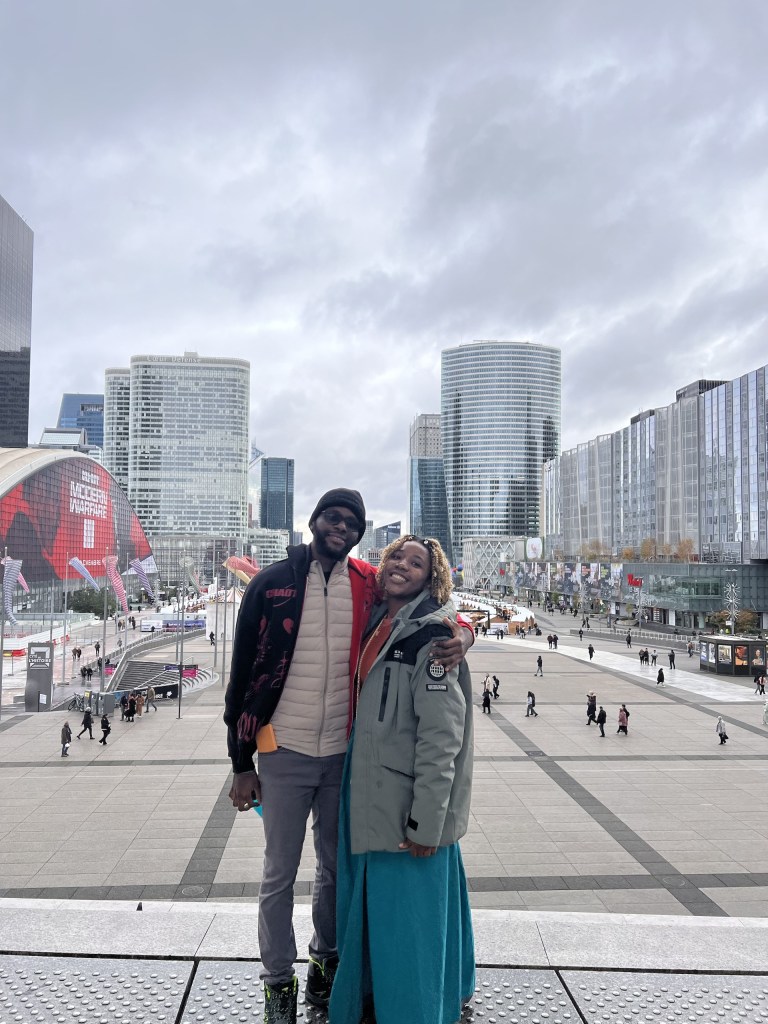
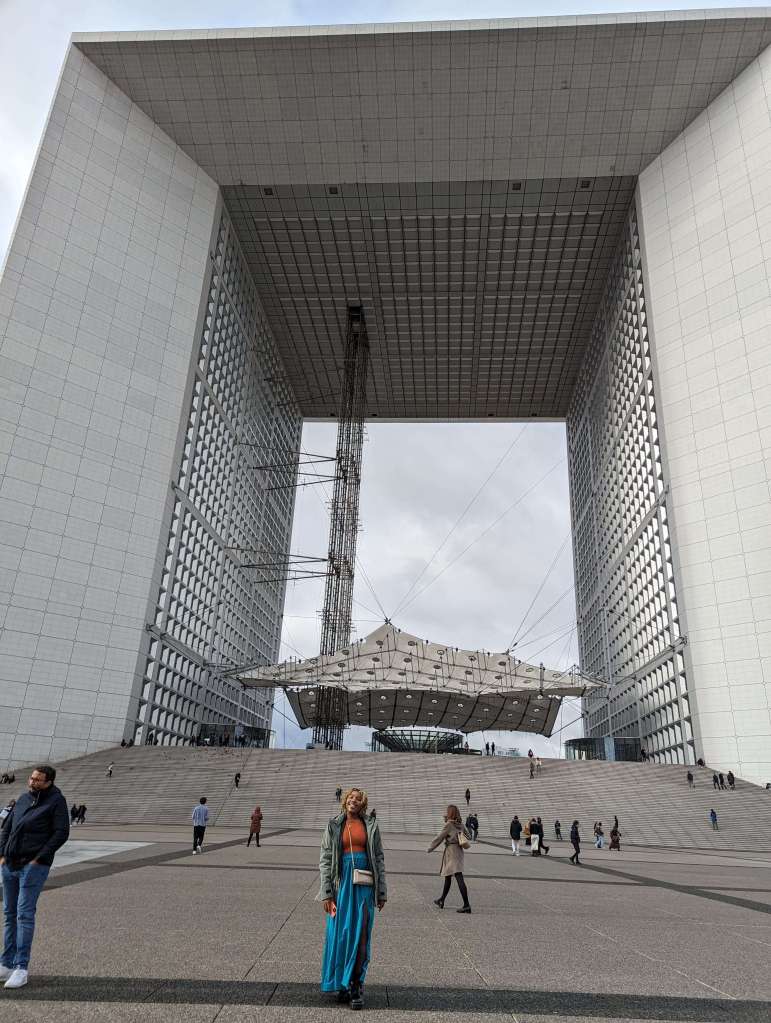
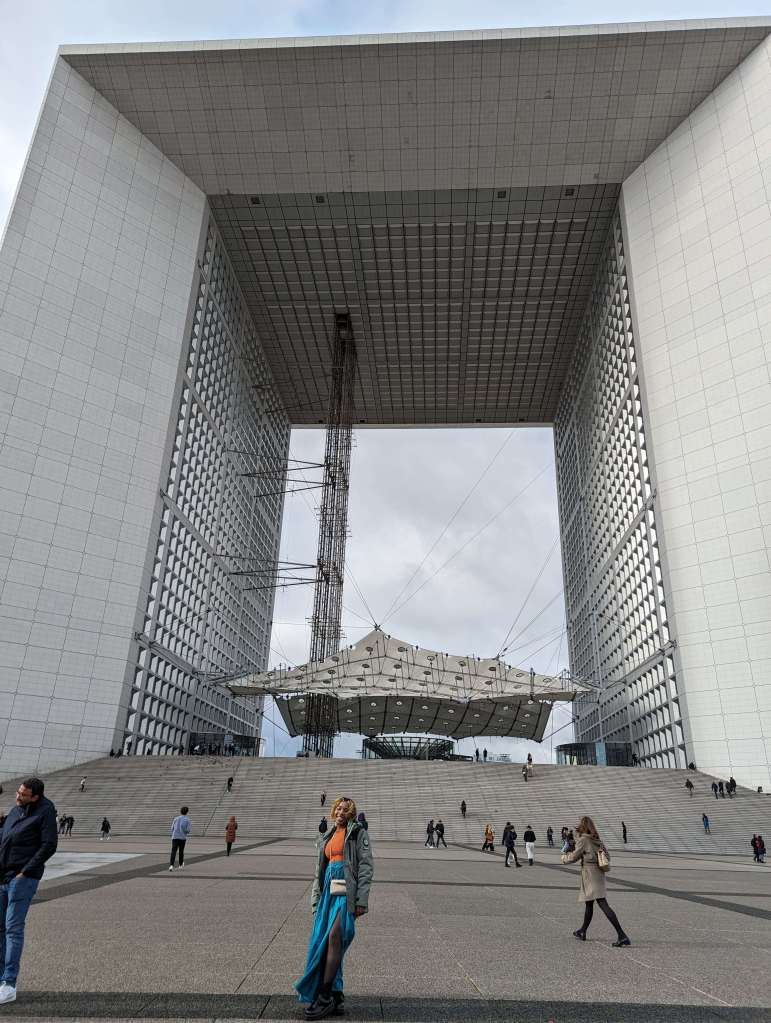
Som had not yet responded to my WhatsApp messages. We walked some more around the Christmas market before we left to explore La Grande Arche de la Défense, a monumental building in the business district of Paris. We counted the stairs as we walked up the flights. Upon arriving at the top, some people were taking photographs; a man was photographing a little girl dressed in a blue dress and black coat before they went back down the stairs.
Some people were just sitting and talking; most groups were in twos. We wanted a photograph together but didn’t find anybody around where we wanted to take a photo. The people we saw were either in twos or occupied with their phones. People came out of the elevators on either side of the La Grande, and we wondered what was going on over there, so we thought to take a look.
We got into the first building on the left and saw a sign that directed visitors to the reception. We went back outside and got into the second building. The revolving doors led us into a building, and when my eyes left my phone, they landed upon a man in a dark suit whose eyes quizzed mine. I looked at the door and saw a bunch of words in French, with the word ‘ecologie.’ I wondered if we had landed upon the Ministry of Ecology in France, which, after a few Google searches, we realised might be the Le Ministère de la Transition écologique et solidaire.
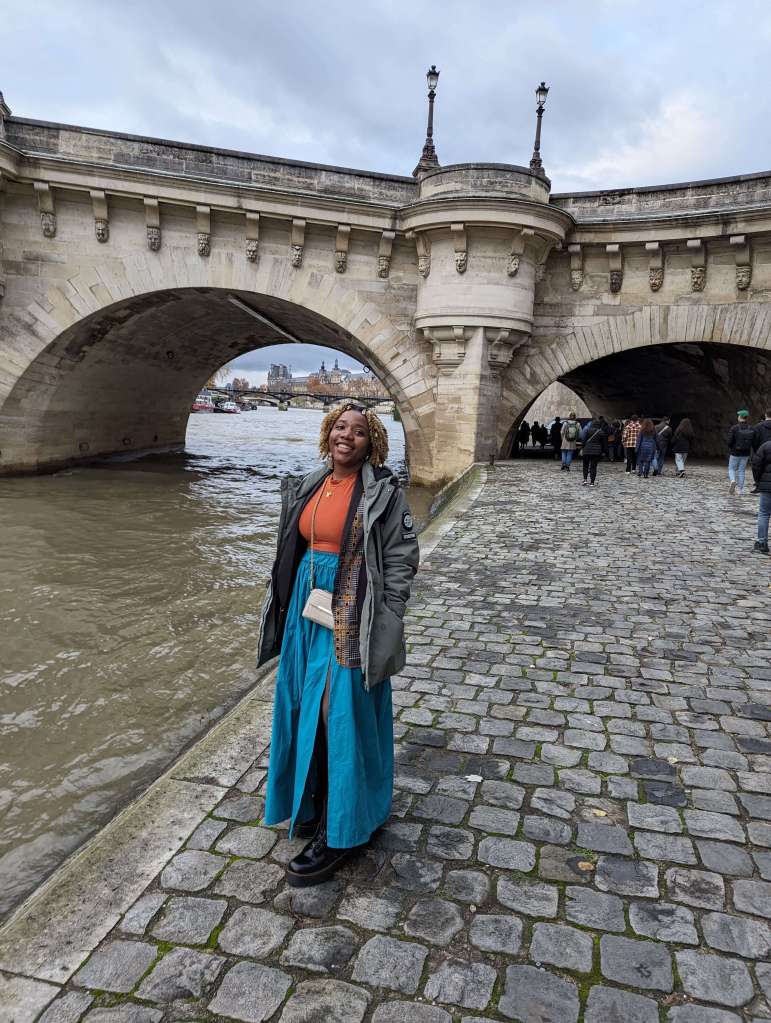
I mumbled, ‘Wrong building,’ and we left, laughing at our mistake. We finally found someone who took a photograph of us. Som still hadn’t responded to my messages, so we left for our tour after I sent a voice note asking if she was okay. The tour lasted 2 hours and 30 minutes, with us exploring the Notre Dame, Hôtel de Ville, Pont Neuf, and Louvre, and ended at Tuileries Garden. Som finally responded, and we agreed to meet at the Eiffel Tower, and thus, we started another journey of about 40 minutes on foot.
Our journey to the Eiffel Tower and the places we stopped at unfolded spontaneously. Our trek to the Eiffel Tower was the climax, a blend of anticipation and fatigue. As we reunited with Som, our exhaustion melted away, replaced by the warmth of friendship’s embrace. She apologised, and I reassured her it was more than okay. After all, things happen, life happens, work happens, but most importantly, we were together, healthy and well, in that precious moment.
We were tourists who had ventured out seeking an experience and encountered a wealth of experiences beyond our expectations. Every moment was worth it: from the impromptu dance at La Défense to eating at the Christmas Market and seeing the grandeur of La Grande Arche to our walking tour, filled with unexpected pleasures, like happening upon random musicians by the Musée du Louvre and the vibrant streets that led us through Tuileries Garden.
Yesterday’s expedition wove a rich tapestry of experiences. If not for those, I wouldn’t have confidently approached a café to use the restroom, recalling the lesson from the working tour to say ‘Bonsoir. Merci, may I pay to use your restroom?‘ The attendant let me in and asked me not to pay.
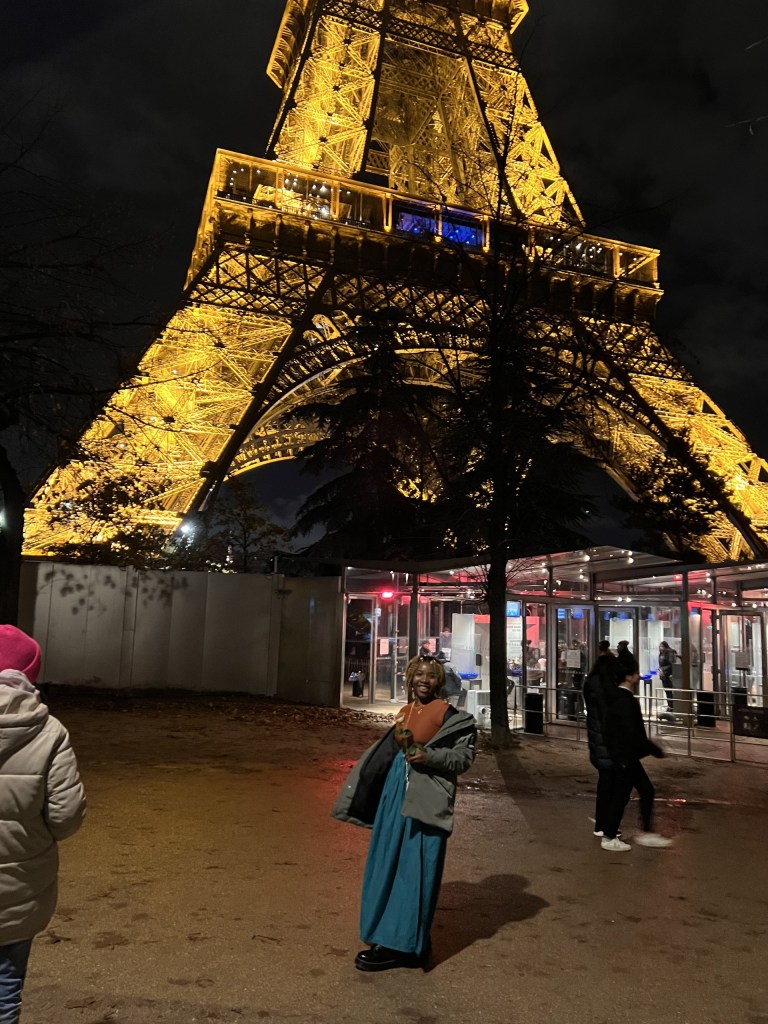
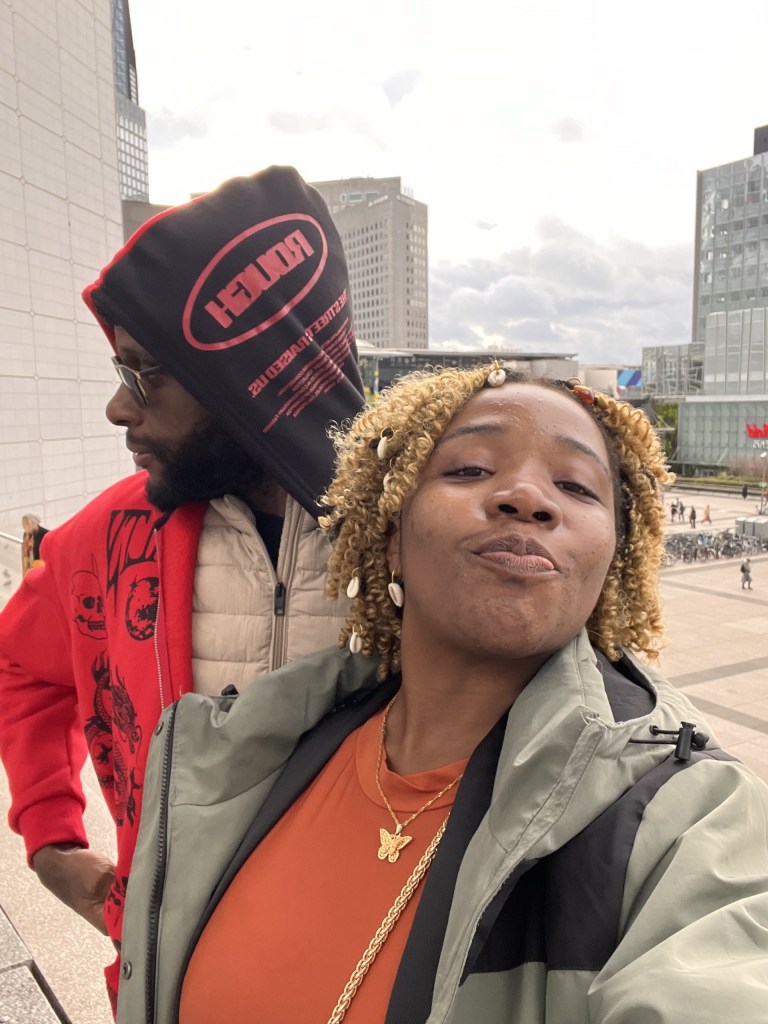
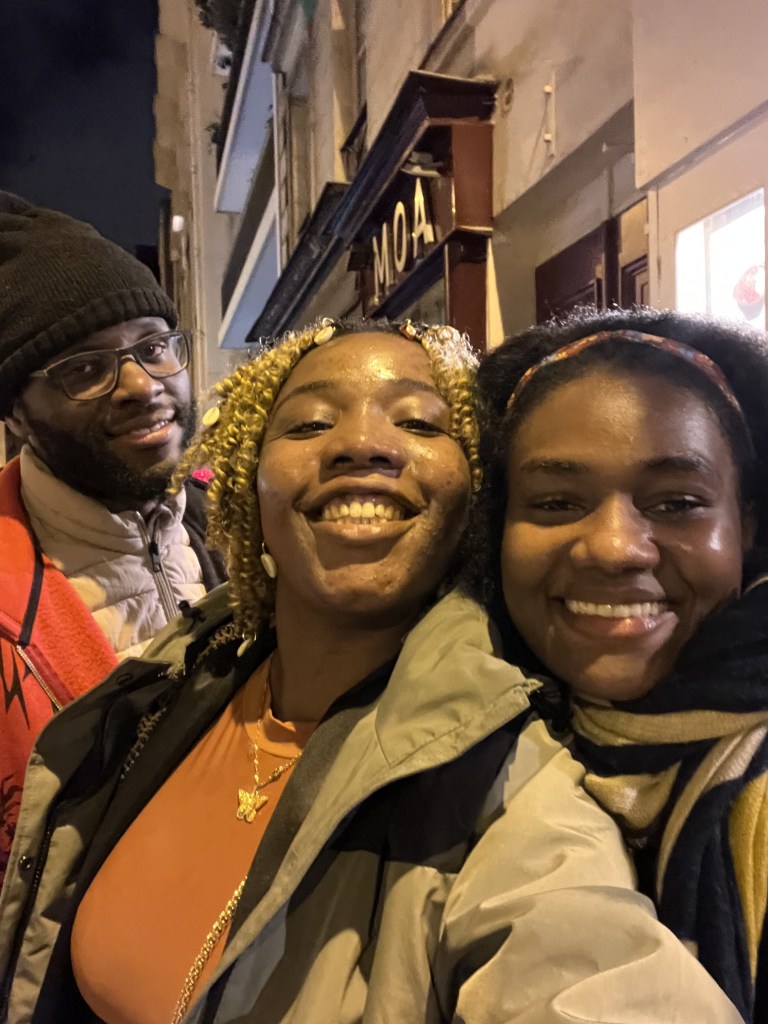
A spontaneous dance performance in La Défense mall, Paris. The vibe is unmatched!A photograph of me in front of the Centre des Nouvelles Industries et Technologies (CNIT), a shopping mall in La Défense, PuteauxA photograph of me at the Eiffel Tower, Paris.A selfie of Shalv and me at La Défense at the top of the stairs of the La Grande Arche de la DéfenseA snapshot of Shalv and me at La Défense at the top of the stairs of the La Grande Arche de la DéfenseA photograph of me at the Pont Neuf (French: New Bridge), the oldest existing bridge across the river Seine in Paris, France. The bridge was built, with interruptions in the work, from 1578 to 1607A photograph of me standing at the foot of La Grande Arche, La DéfenseA photograph of me standing at the foot of La Grande Arche, La DéfenseA photograph with Chisom and Shalv.
My reaction when I saw the Eiffel Tower
I share the highlights of my adventures in Europe on my Instagram stories. You can follow my time in Paris through this link.
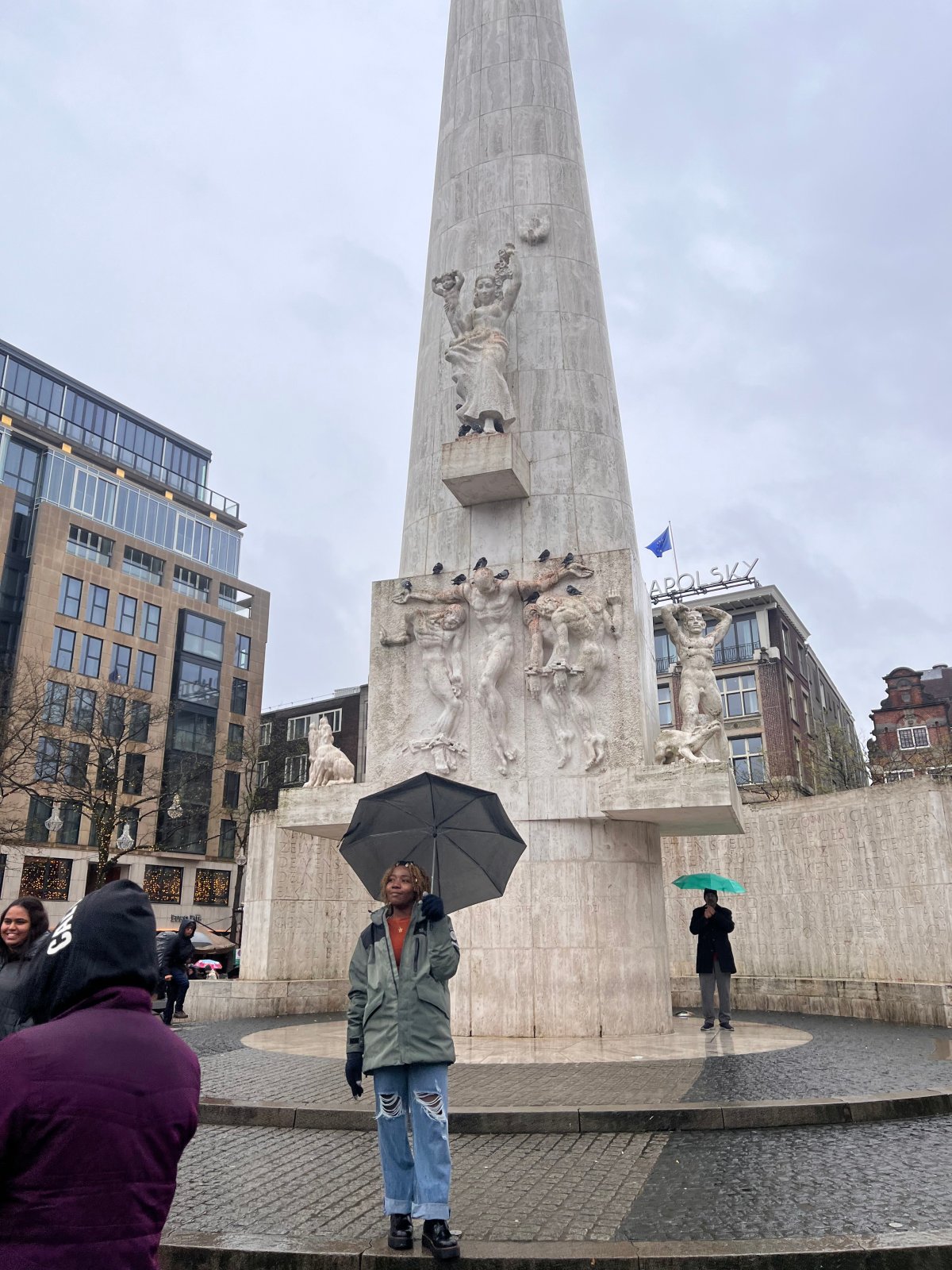
A photograph of me in front of the National Monument on Dam Square (Dutch: Nationaal Monument op de Dam): a monument dedicated to all Dutch war casualties of World War II. Opposite it is the Royal Palace.
PS: Consider these travel stories as entries from my journal.Written in haste, I hope you find enjoyment in their spontaneity and rawness.
I was fascinated by how the tour guide recounted the origins of the Netherlands on the tour today. With her expertise in the history of her country, I can only imagine how much knowledge of the country the locals have access to. She showed us a demographic map of Amsterdam’s Jewish population in 1941, which the Nazis used to facilitate persecution, and confessed she was only just learning about this because the Dutch were ashamed of that part of their history — a history of how the Dutch also had a hand in the persecution of the Jews. ‘Now you know more than some of the locals,’ she concluded.
These past two weeks in Europe have been a journey of enlightenment, learning more about the world than I knew before I arrived. But as I soak in this knowledge, I can’t help but feel a pang of sadness for the untold stories of my ancestors. I wonder how much of our stories are out there. What do people know about us? And more critically, what don’t we know about ourselves? How much of our stories are not accessible to us?
I have been contemplating the importance of telling and owning our stories. What is the Nigerian story in the context of the world wars? What is the Nigerian story beyond these wars?
During the Berlin tour, the tour guide briefly mentioned the Berlin Conference. Shalvah and I, being the only Nigerians in the group, stood out for our complexion and accent. This distinction drew his attention to us. His passing comment about the conference made me uneasy; I was hesitant to hear the Nigerian story narrated by someone else.
My reflection is of a larger issue — the absence of our narrative in the mainstream. We don’t actively tell our stories; we don’t teach history in schools. Most of what I know came from my own research. History should be a recommended subject in schools. How do we tell the Nigerian story if we don’t actively talk about it?
If we don’t tell our stories, they are left open to others’ interpretation. To paraphrase Otto Frank, we cannot change what happened, but we can learn from the past to prevent history from repeating itself. Moreover, we must write and preserve our narratives, for if we don’t tell our stories, who will?
Writing our stories is not just an act of preservation but also a means of asserting our place and perspective in the historical record.
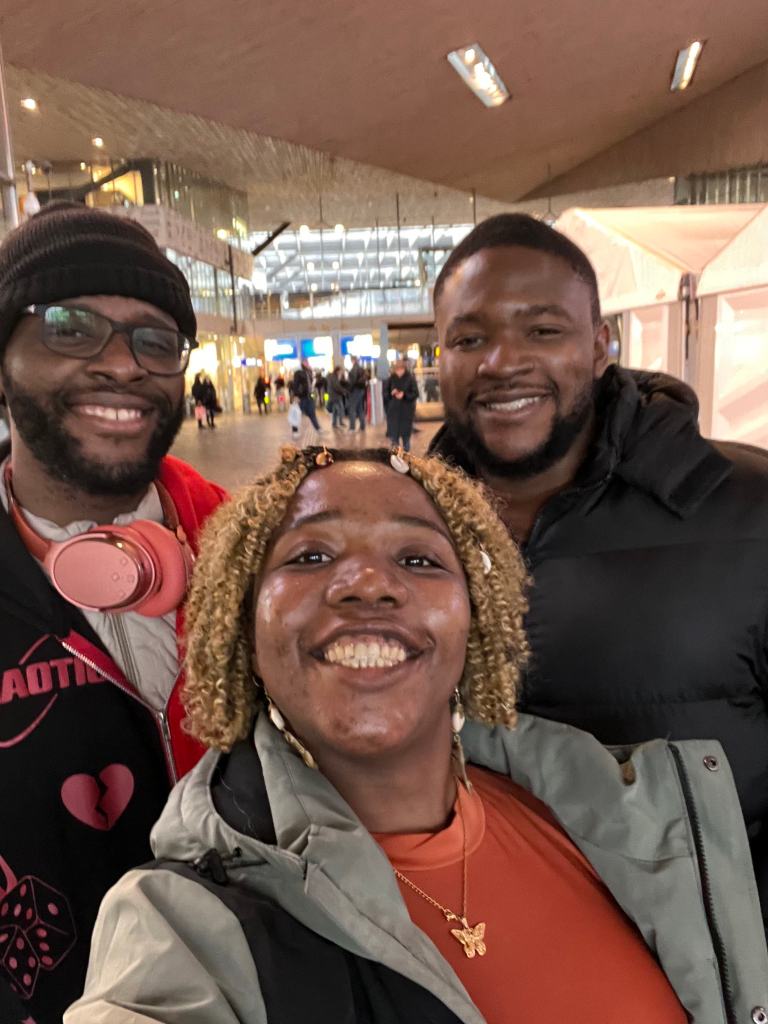
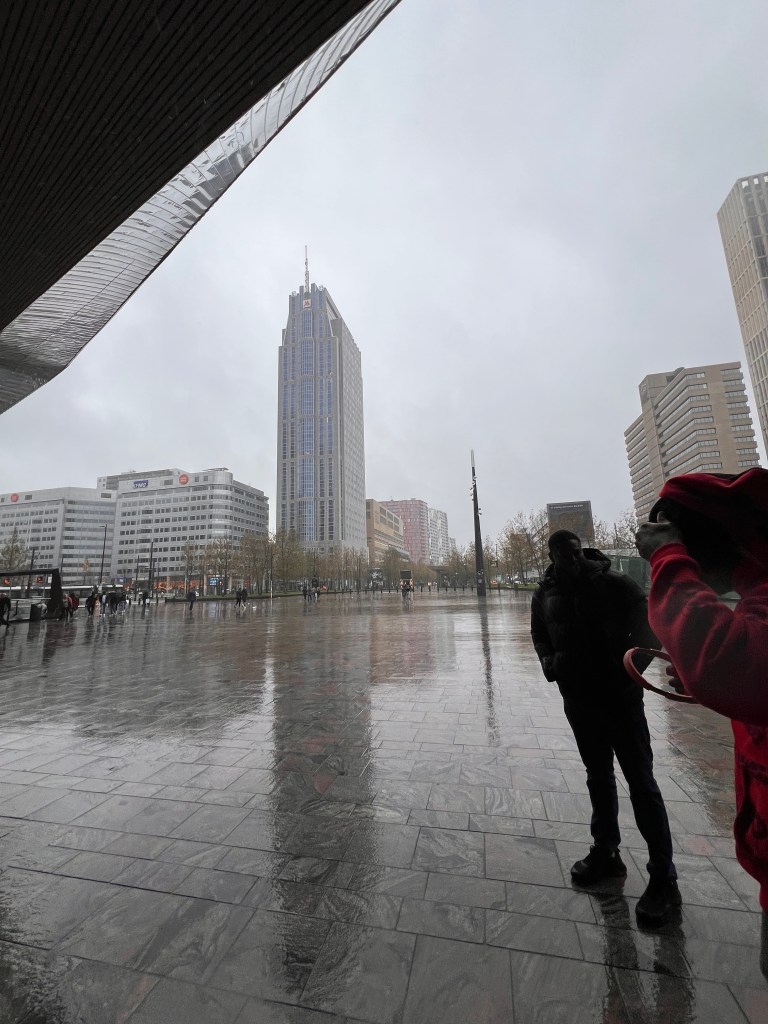
Yet, there are lighter moments that bring joy amid these ruminations. It rained throughout the day, and I struggled to keep my umbrella in place, but I was especially grateful for reuniting with an old friend, Timmy in Rotterdam. He treated us to the delights of Mama Thai’s restaurant, offering the most delicious meal I’ve had in the Netherlands. We skipped visiting Erasmus Bridge (Dutch: Erasmusbrug) due to the weather, but that gave us more time at his house to continue our discussion about the African narrative over apples and cashew nuts. We promised to continue this conversation fuelled with curiosity and a commitment to active learning.
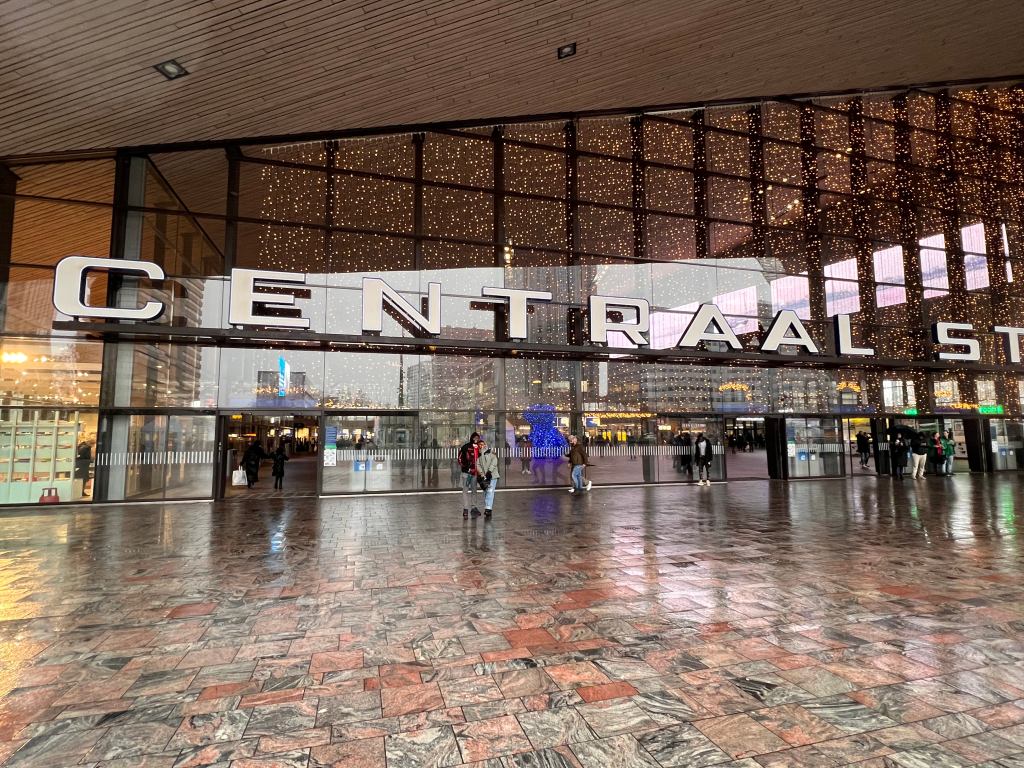
A snapshot with Shalvah and TimmyA photograph of Shalvah and me in front of the Centraal Station, Rotterdam.Rainy days and city lights – a view from under a shelter looking out at Rotterdam Centraal, with Timmy adding to the urban vibe
I share the highlights of my adventures in Europe on my Instagram stories. You can follow my time in The Netherlands through this link.
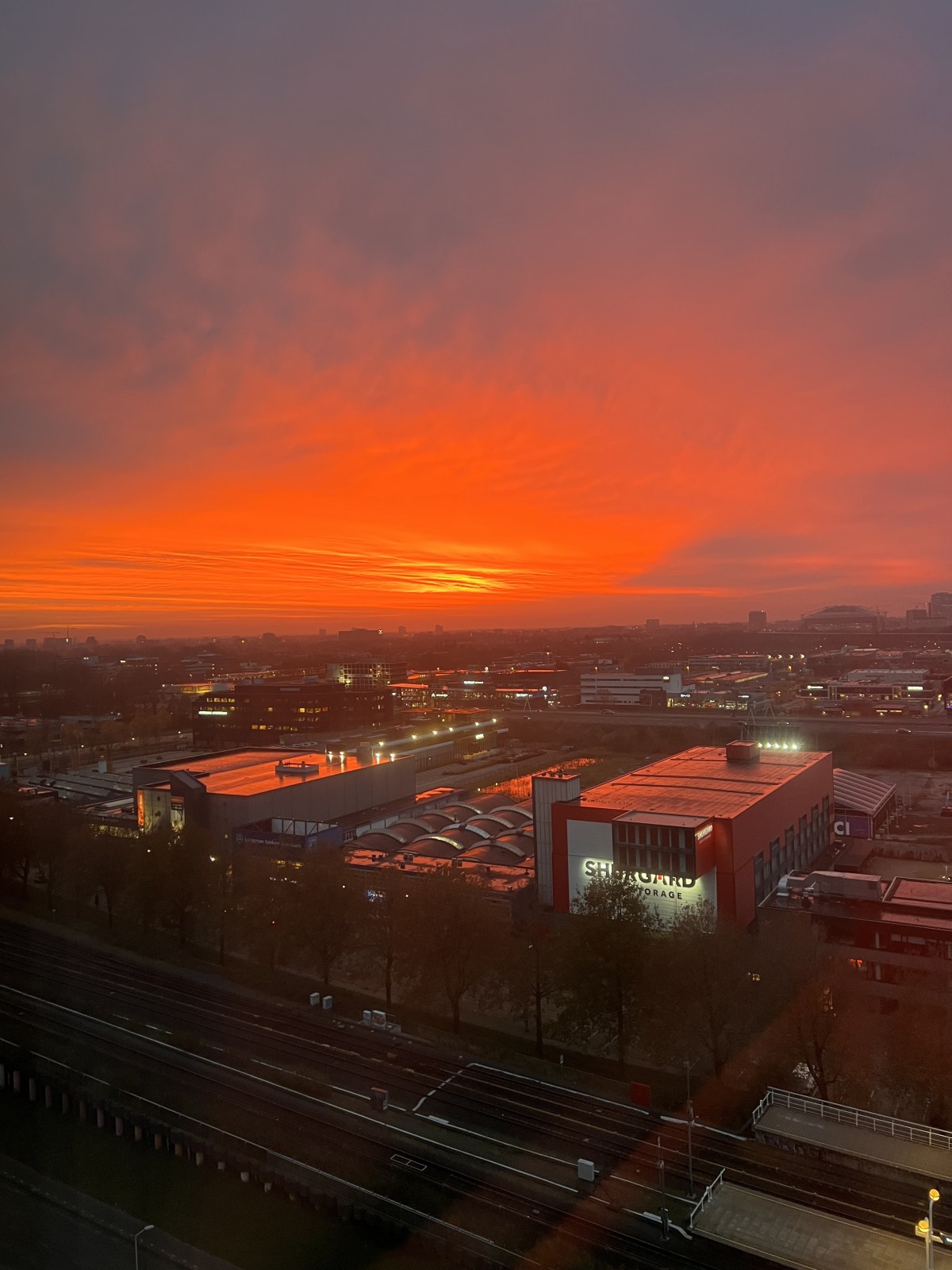
Dawn's fiery canvas over Overamstel, as viewed from my hotel room at the Leonardo Royal Hotel. The rising sun painting the sky in vibrant hues of red and orange, marking a serene start to a new day in Amsterdam, with the calm presence of a canal just beyond the frame.
I am in Amsterdam, the city of canals. Writing from my window in a hotel, 14 floors up, I’m captivated by the beautiful view of moving vehicles and the canal, its lights reflecting on the water. It’s 5:32 AM, and sleep eludes me. Today’s agenda includes a city tour and a subsequent trip to Rotterdam to meet my long-time friend, Timmy. My feelings are a mix of worry, nervousness, and gratitude.
It’s intriguing that I could experience these three emotions simultaneously. How does apprehension intertwine with gratitude? I’m yet to find out.
It’s my second day in The Netherlands, marking my 18th day in Europe on a fast ticking Schengen visa.
Yesterday was gruelling. My period came with a nerve-wracking pain that left me wishing for an escape to a different life. Once the pain seemed to have eased, Shalvah and I embarked on a boat cruise, a change from our original plan due to missing the city tour. We sailed through Amsterdam’s canals exploring the city’s history in a boat with three seats per row, which I thought defeated the purpose of the ‘lovers boat cruise’ ironic given its name.
Amsterdam, a stark contrast from yesterday’s bustling streets, now seems tranquil. My initial impressions of the city, influenced by the ubiquitous smoking and weed-friendly establishments, led to a hasty generalisation of the country belonging to the drug barons. It’s my first encounter with a place where weed is so openly accepted.
Amsterdam differs from Germany, yet shares similarities. While cash is favoured in Germany, Amsterdam leans towards digital transactions, highlighting its tech-savvy nature. As a foreigner, adapting to this was initially overwhelming, particularly at the train station with our ‘I amsterdam’ city card, which we discovered doesn’t include NS trains.
The Dutch are also more open towards speaking the English language in contrast to Germans who you have to ask ‘Please, do you speak English,’ before they respond either in the affirmative or ‘Keine English.’
Last night’s quest for relief from menstrual cramps led me to the hotel bar for chamomile tea. The Dutch, much like the Germans, cherish their teas. The warm brew, along with the barman’s kindness, was a comforting end to the day, adding to the series of warm encounters I’ve received on this continent.
So far, my time in Amsterdam has been filled with highs — from exploring the city and navigating restaurants to the serenity of a boat cruise and the joy of capturing moments in photographs. Each experience layers onto my understanding and appreciation of this distinctive city, and I look forward to learning more about The Netherlands and what Rotterdam has in store later today.
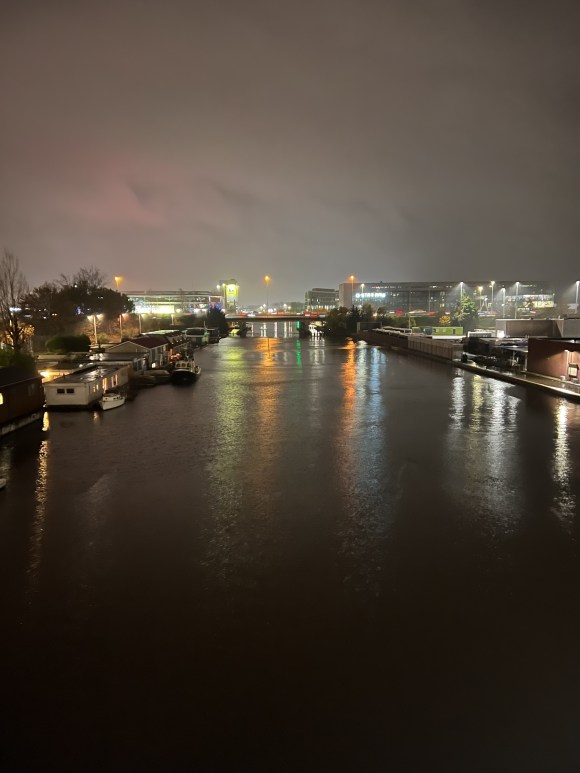
A view of Overamstel’s serene waters, where city lights meet the calm canal
I share the highlights of my adventures in Europe on my Instagram stories. You can follow my time in The Netherlands through this link.
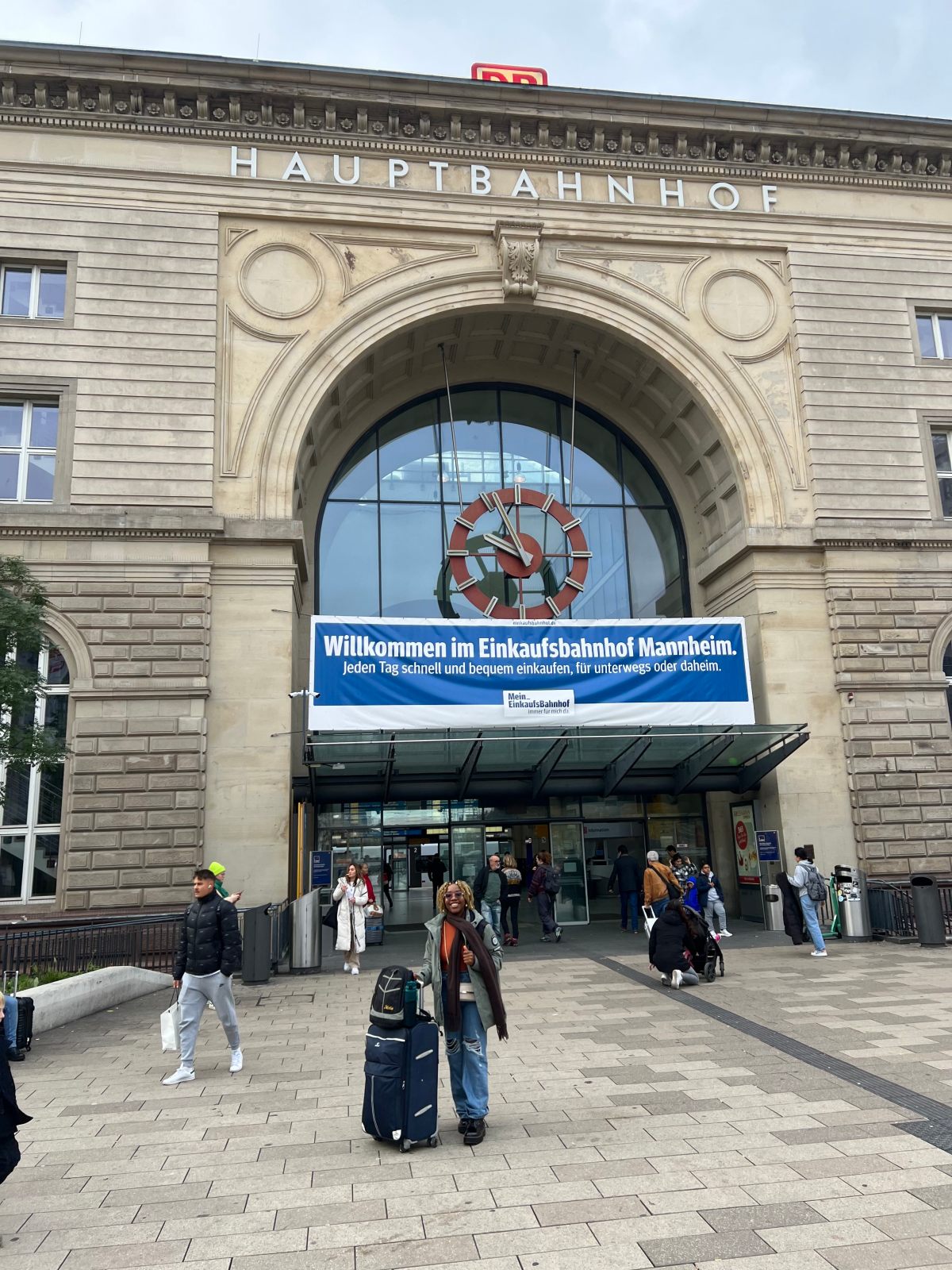
A photograph of me, luggage in tow, at Mannheim Central Station — the starting point of my next adventure to Berlin!
PS: Consider these travel stories as entries from my journal.Written in haste, I hope you find enjoyment in their spontaneity and rawness.
You can tell it’s different here. The way the air shifts from the smoky haze of people smoking together to the freshness of nature’s embrace is striking.
It’s been two weeks since I first set foot on German soil, and I’ve been collecting experiences like mementos. I spent my initial days in Heidelberg bundled in warm clothing, exploring the city with Shalv. My first meal in Germany was at Starbucks in Frankfurt, where I enjoyed croissants and a latte macchiato with oat milk. Back in Nigeria, I’d never have considered croissants more than a snack. But since I’ve stayed here for some days now, I almost feel like a tourist, eating croissants and bagel for breakfast, with a cuppa tea or coffee please.
I try to approach each experience with the eager eyes of a newcomer. Everything is fresh, exhilarating, almost like seeing the world through the lens of a child. I’m excited, enthused, exhilarated. I had never seen such a diverse gathering of people with different skin colours; it was a stark contrast to what I’m accustomed to back home. It’s not the complexion that excites me, but the immersion in a culture so different from my own, so rich with diverse experiences.
Things are different here, but not ‘bad different.’ Just not the same. In my first days, I sought something familiar in the faces of the people I encountered — a smile, a nod, an acknowledgement, something that tells me I could find a community here. But I didn’t see anything. I didn’t get a nod, and I couldn’t find anything in their eyes, perhaps, because everyone is in a rush in this country.
My first jolt of culture shock when I arrived in Germany hit at Terminal D, where I saw several people smoking together in one place. Someone was smoking in front of some kids, and I thought, ‘these kids are inhaling second-hand smoke. How is this normal?’ As an overly health-conscious woman, I felt an immediate need to remove myself from what I perceived to be a hazardous environment. ‘How is this normal?’ I asked myself again as the smoke wafted through the doors I was using as a shield.
But when I arrived in Berlin two Fridays ago, the pace quickly picked up, and it almost felt like I was in Lagos again, except that the sun didn’t set at 5:00 PM and rise at 7:00 AM in Lagos as it did in Berlin. I had forgotten to bring my phone charger, so I wondered where I could purchase one. Thankfully, the hotel receptionist came to my rescue, kindly offering a charger I could use throughout my stay in the hotel.
The next hotel we stayed at was the Holiday Inn in Prenzlauer Allee, Berlin. I was not on leave from the 7th to the 9th of November, so I worked during these days. On Wednesday, the 8th of November, a fire scare sent the hotel guests sprinting outside for safety. After the incident, I finished my work from the lounge.
I had wanted to get water, but, frightened by the recent events, I stayed put, shuffling my feet and immersing myself in more work. It wasn’t until I looked up that I noticed a hotel attendant with the most beautiful smile and kindest eyes, whom I’d later come to know as ‘Betty,’ approaching me with a glass of water. ‘I thought you might like some water. You’ve been so busy working,’ she said with a gentle smile. My heart leapt, and I captured the moment with a photo.
The next day, when I came downstairs with a water bottle, Betty approached my table again, this time with an empty glass adorned with a sprig of lemon. ‘I saw you brought your water, so I brought a cup for you,’ she said. My work leave started the following day. When I came downstairs to meet a new friend, I saw her in the lobby. After exchanging pleasantries, she remarked, ‘I hope you are not working today, so you can take time to see the city.’
My experiences at the hotels in Berlin, and those outside, including meeting new friends, reuniting with old friends, learning about the world through our first Saturday tour in Berlin, and exploring new cultures through foods, experiences, and sights, have been incredibly humbling and gratifying.
There’s much more happening around us than we realise, and this is what travel does; it reveals the vastness of life around us, and helps us see our place in the world by positioning us within a global context, highlighting our similarities despite our diverse backgrounds.
Through my journey in Europe, I am continually discovering a new reality, realising that this adventure is not just about exploring Europe, but also about rediscovering myself. It’s about finding familiarity in the unfamiliar, meeting people — that is truly seeing them, and learning that home isn’t just a place, but a sense of belonging that deepens with each new experience.
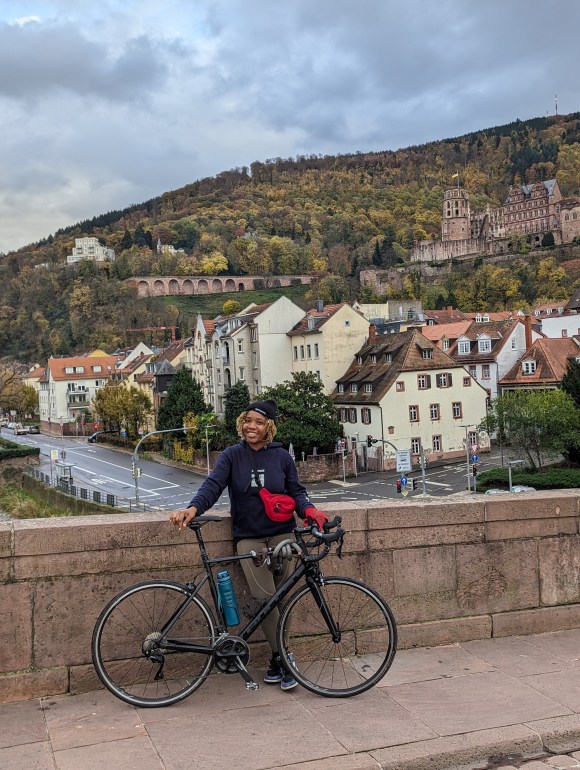
A photograph of me with a bicycle by the Alte brücke (Old Bridge) in Heidelberg, with the historic Heidelberg Castle providing a majestic backdrop.
I share the highlights of my adventures in Europe on my Instagram stories. You can follow my journey through this link.